NECA Awards Video Series: Serving Communities in Boston and Across Borders Through Compassion and Selfless Service
In an exclusive interview with INDIA New England News, Coordinator Kumar Subramanian and Joint Coordinator Neha Kaushal Mishra discuss the organization's work in Massachusetts, humanitarian initiatives in India, disaster relief around the world, and its philosophy of serving humanity without discrimination.

BOSTON— From providing STEM education to students in Massachusetts and nutritious meals to underserved communities to empowering women and girls in rural India and responding to natural disasters around the world, Sewa International has built a humanitarian service network that reaches far beyond geographical and cultural boundaries.
For Sewa International Boston Chapter, the mission is guided by a simple but powerful philosophy: the world is one family.
In an exclusive interview with INDIA New England News, Kumar Subramanian, Coordinator of Sewa International Boston Chapter, and Neha Kaushal Mishra, Joint Coordinator, discussed the organization’s history, its growing community service initiatives, the importance of volunteerism, and its commitment to helping people regardless of their religion, background, or country of origin.
The Boston chapter has been named Nonprofit Organization of the Year 2026 at the New England Choice Awards. The organization will be formally honored at the New England Choice Awards Gala on November 14, 2026, at the Burlington Marriott in Burlington, Massachusetts.
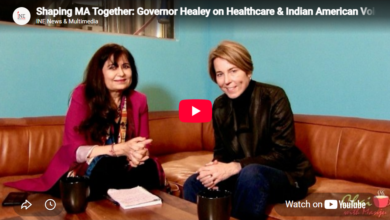
To watch the full interview, please click here, or on the image below:
From a Small Beginning to a Global Humanitarian Network
Sewa International was founded in 2003 and has since expanded into a global humanitarian organization with more than 40 chapters in the United States and a presence in over 20 countries.
According to the organization, its network includes approximately 6,000 volunteers and its humanitarian initiatives have touched more than two million people.
Explaining the organization’s evolution, Subramanian said Sewa International focuses on disaster relief, public health, education, and community development.
“Our guiding principle is the philosophy of Vasudhaiva Kutumbakam, which means the world is one family,” he said. “You will be able to see that in all the work that we do. We do it all across the world. We have different kinds of recipients and beneficiaries, but we believe that we are all one family.”
For Subramanian, the philosophy is not simply a statement of belief but something that must be reflected in everyday service.
He explained that the organization follows the principles of the Shanti Mantra, a prayer wishing peace and happiness for all living beings.
“Everybody on this planet, living or non-living, is worthy of our service. There is no discrimination of any sort. Everybody has to be happy. This is our guiding principle,” he said.
Serving Communities in Massachusetts, Regardless of Background
One of the most important aspects of the interview was the officials’ emphasis that Sewa International’s work is not restricted to any particular religious, ethnic, or cultural community.
The Boston chapter supports several local initiatives, including food assistance, educational programs, fundraising for shelters, and volunteer activities with community organizations.
Subramanian cited several examples of the chapter’s local outreach.
“We raise funds for Cor Unum, which is a charity in Lawrence, and we raise funds for feeding over 300 people,” he said, describing the chapter’s food assistance efforts.
He also mentioned fundraising for Abby’s House, a women’s shelter in Worcester, as well as volunteer activities involving youth groups helping clean churches in Massachusetts.
“Our activities are spread across all communities that are in need, and we want to go and help everybody. Irrespective of who they are, we are all one family, and that’s what you can see in our actions,” Subramanian said.
These examples underscore the chapter’s approach to community service: identifying local needs and bringing volunteers and resources together to address them.
Aspire: Bringing STEM Education to Students in Lowell
One of the Boston chapter’s most significant local initiatives is the Aspire Program, a STEM enrichment and mentoring program for middle school and high school students in Lowell Public Schools.
The program offers after-school educational opportunities in science, technology, engineering, robotics, and related subjects.
Mishra explained that the initiative provides students with additional hands-on learning opportunities beyond their regular classroom education.
“Aspire basically is a STEM enrichment after-school program that we are running for local public school systems for middle schoolers and high schoolers,” she said.
Students interested in exploring engineering, robotics, and other STEM-related subjects receive approximately two to three hours of additional instruction.
The program also works with local public school teachers, while donor support helps address practical barriers such as transportation.
The chapter launched its first Aspire session with approximately 67 students. According to Mishra, the first group completed the program successfully, and the chapter was excited about the next session, which had already attracted approximately 65 enrolled students.
“We were very proud to have 67 students graduate last year from this program. We have started our second program, and we have around 65 students who are already enrolled. They are loving the program,” she said.
Aspire is particularly significant because it demonstrates how Sewa International’s philosophy of service translates into practical educational opportunities for children in the local community.
Mishra emphasized that the program is open to students regardless of caste, religion, or background.
SHIE: Empowering Women and Girls Across 18 Indian States
While Aspire focuses on education in Massachusetts, another major Sewa International initiative, known as SHIE, addresses the needs of women and adolescent girls in India.
SHIE stands for Sanitation, Hygiene and Empowerment of Girls.
Mishra, who has been associated with Sewa International for approximately eight years, said the program was one of the primary reasons she became involved with the organization.
“I think what attracted me to Sewa was its SHIE program, which stands for sanitation, hygiene and empowerment of girls. It is very much geared toward adolescent girls and women in India,” she said.
The program is currently active in 18 states in India and has helped approximately 50,000 adolescent girls through menstrual health education and related awareness initiatives.
It has also provided skills-based training to more than 4,500 women.
The activities include menstrual education, sanitation awareness, computer training, stitching, traditional arts and crafts, entrepreneurship, and livelihood development.
Mishra said the organization also works in rural communities where access to basic sanitation facilities remains a significant challenge.
“We are going into these areas, working with the government, trying to build toilets for these girls, educating them on menstrual health, and running camps for them,” she explained.
The program has expanded to include self-defense, yoga, and mental wellness education as part of a broader effort to support girls’ health, confidence, and empowerment.
Mishra also noted that a recent Supreme Court ruling in India concerning menstrual health and equity has reinforced the importance of the organization’s work.
She said the ruling gives the organization greater confidence that its efforts to improve menstrual health education and access to sanitation are moving in the right direction.
Creating Economic Opportunities for Women
Beyond health and sanitation, Sewa International’s work in India also includes helping women develop skills that can generate income and improve their financial independence.
Mishra described two particularly meaningful examples.
In Ayodhya, the organization recently completed training for approximately 60 women in stitching and sewing.
The women were taught basic sewing skills and provided with sewing machines so they could begin earning an income.
“These are women who actually needed to meet their basic needs. We have taught them stitching from the basics and given them sewing machines afterward. They are now financially independent,” she said.
Another initiative focuses on women in Hyderabad, where Sewa volunteers and local trainers have helped women learn the traditional craft of making lacquer bangles.
Mishra said the women have progressed to the point where they are making and selling bangles to earn their livelihoods.
She even wore some of the bangles during the interview, explaining that they were made by women participating in the program.
“We are including anyone and everyone in our family. So we are definitely abiding by that principle,” she said.
The initiatives demonstrate how Sewa International combines education and social empowerment with practical economic opportunities.
Disaster Relief: From Hurricane Katrina to International Emergencies
Disaster response has been another major component of Sewa International’s humanitarian work.
Subramanian pointed to the organization’s response to Hurricane Katrina in 2005 as an example of the impact volunteers can make during major emergencies.
He recalled that the services provided by Sewa volunteers were recognized by the mayor of Houston, who presented the president of the Houston chapter with the key to the city.
More recently, Sewa International volunteers participated in relief efforts following the devastating July 2025 floods in Texas Hill Country.
Subramanian said the organization worked with the Federal Emergency Management Agency (FEMA) and was entrusted with volunteer management responsibilities during the response.
“SA volunteers were on the ground. Sewa is a partner with FEMA, and the entire volunteer management organization was given to Sewa by FEMA. That’s the kind of trust they have and the connections we have,” he said.
The organization has also been involved in international humanitarian efforts.
Subramanian cited Sewa’s response to the Ukraine war, where volunteers helped refugees arriving in Poland.
He explained that while many organizations were providing food and drinks, Sewa volunteers identified another practical need: charging mobile phones.
“Everybody was providing food and drinks, but Sewa was providing chargers for the phones,” he said.
He described this as an example of the organization’s approach to humanitarian assistance: identifying gaps in existing relief efforts and providing services that may otherwise be overlooked.
The organization has also been responding to recent flooding in Nepal. Subramanian said Sewa’s leadership team visited the affected region and that the organization was supporting more than 10,000 children, with over $200,000 raised for continuing relief work.
Why Sewa’s Message Is About Everyone
During the interview, Mishra and Subramanian were asked about perceptions that Sewa International primarily serves a particular religious community.
Both emphasized that the organization’s guiding philosophy is universal service.
Mishra said she was pleased that INDIA New England News had attended one of the chapter’s local service events and witnessed its community initiatives firsthand.
She pointed to the Aspire Program as a clear example of the organization’s inclusive approach.
The program serves students in public schools without discrimination based on caste, religion, or background.
Subramanian reinforced the point by referring to the organization’s guiding prayer and philosophy.
For him, the measure of Sewa’s work is not the identity of the people receiving assistance but whether there is a genuine need that volunteers can help address.
The chapter’s support for food assistance programs, women’s shelters, churches, schools, and other community organizations in Massachusetts reflects that approach.
The People Behind the Service
The interview also offered insight into what inspired the two Boston chapter leaders to become involved with Sewa International.
Subramanian said he was introduced to the organization through a mutual friend, Ashwani, after he and his family had established themselves in the United States.
“I was looking for some avenue or platform for service that I could join,” he said.
After learning about Sewa International, he began volunteering and gradually took on greater responsibilities within the Boston chapter around 2019.
For Mishra, the connection began after attending a Sewa event in approximately 2018 or 2019.
She learned about the SHIE program and felt an immediate emotional connection to its mission of supporting women and girls.
“I learned about the SHIE program, and that kind of just had a very emotional connection with me,” she said.
She subsequently contacted the organization’s volunteers, was introduced to the SHIE team in India, and began volunteering with the program.
Both stories reflect a common theme: people who initially become involved through a personal connection or a particular cause often develop a deeper commitment to community service.
Nonprofit Organization of the Year 2026
Sewa International Boston Chapter’s growing community impact has now earned it recognition as Nonprofit Organization of the Year 2026 at the New England Choice Awards.
The chapter will be honored at the New England Choice Awards Gala on November 14, 2026, at the Burlington Marriott in Burlington, Massachusetts.
The award recognizes the organization’s commitment to volunteerism, education, food security, healthcare, disaster relief, and community service.
For the Boston chapter, the recognition represents the collective efforts of its volunteers, community partners, donors, and leadership.
From helping students explore STEM careers in Lowell to empowering women in rural India, from providing meals to underserved families in Massachusetts to supporting disaster-affected communities internationally, Sewa International’s work reflects its central philosophy that humanity is one family.
As Subramanian emphasized during the interview, that philosophy is best understood not through words alone but through actions.
And for Sewa International Boston Chapter, those actions continue to bring volunteers and communities together in the spirit of compassion, inclusion, and selfless service.