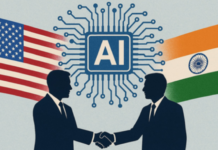

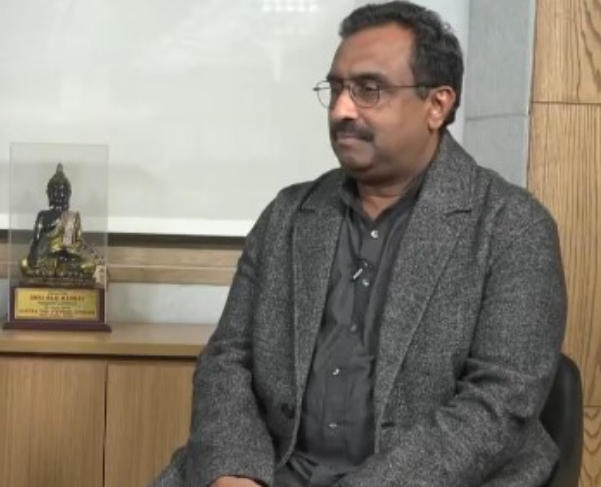

WASHINGTON — India and the United States are going through a challenging but potentially temporary phase in their bilateral relationship, with trade negotiations, tariff disputes, and geopolitical differences creating friction, senior Bharatiya Janata Party leader Ram Madhav said during an interaction with the Indian diaspora.
Addressing a gathering organized by the Overseas Friends of BJP, Madhav said expectations in India were high following President Donald Trump’s return to office, but recent developments had been unexpected.
“This was not expected. As our party also said, when Trump 2.0 happened, there was a lot of enthusiasm in our camp also,” he said, noting that Trump continues to enjoy significant support among many in India.
Madhav said India’s experience with Trump was not unique. “That is the experience of many countries in the world with Trump. President Trump has his own style, his own way of dealing with countries, dealing with issues,” he said.
On trade and tariffs, Madhav said India has shown a willingness to negotiate and that discussions between the two sides have been underway for several months. “Our commerce ministry and department of commerce here have been holding talks for almost eight, nine months,” he said, adding that the negotiations were “very close to a deal.”
He cautioned, however, that trade talks become complicated when linked with geopolitical concerns. “What complicates the matter is when trade issues are mixed up with geopolitics,” he said, referring to attempts to connect trade discussions with India-Pakistan tensions.
Madhav said India has firmly rejected any such linkage. “On this issue of India-Pakistan, we have a clear-cut policy that it will only be a bilateral issue. There is no role whatsoever for any third country to play in this,” he said, adding that India had conveyed this position clearly to Washington.
“We politely told that one should not mix up geopolitics with trade,” he said, noting that trade negotiations are now being handled separately.
He also pushed back against suggestions that policy decisions could be finalized informally. “India takes matters too seriously. Policies cannot be phone-call away,” he said, stressing that trade agreements require detailed and structured negotiations.
Despite the current difficulties, Madhav said there was no desire in New Delhi to undermine the broader partnership. “This relationship is far more important for us, much more important than individuals,” he said.
He credited former Prime Minister Atal Bihari Vajpayee with laying the foundation of modern India-U.S. relations, recalling Vajpayee’s view that the two countries are “natural allies” whose partnership has been built steadily over decades.
Madhav also highlighted the role of the Indian diaspora in strengthening bilateral ties. “Indian Americans have been a very important element in this relationship,” he said.
Describing the current tensions as short-lived, Madhav said the challenges were not rooted in policy differences. “There are a few hiccups which are essentially personality-oriented, not at all policy-oriented,” he said, adding that India remains committed to restoring momentum in the relationship. (Source: IANS)