Margaret Abraham to Be Featured Guest Speaker at Saheli’s 30th Anniversary Gala in Boston
Pioneering sociologist who brought domestic violence in the South Asian diaspora into public discourse says awareness has grown over three decades, but significant barriers, funding gaps and lack of comprehensive data remain.
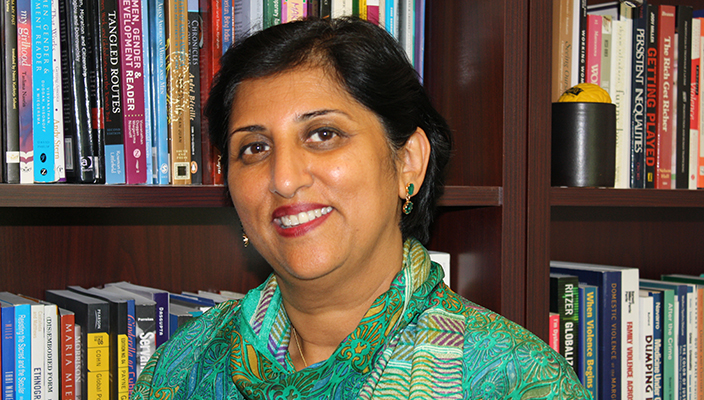

CAMBRIDGE, Mass. — Margaret Abraham, an internationally recognized sociologist and pioneering researcher on domestic violence in the South Asian immigrant community, will be a featured guest speaker at Saheli’s 30th anniversary Nirbhaya Gala on Saturday, December 5, 2026, at the Hyatt Regency Cambridge.
A professor of sociology and the Harry H. Wachtel Distinguished Professor at Hofstra University in New York, Abraham has spent more than three decades researching, teaching and advocating for social justice, with a particular focus on ethnicity, gender, migration and domestic violence.
In an interview with INDIA New England News ahead of the gala, Abraham reflected on how the understanding and visibility of domestic violence in South Asian communities have evolved, the barriers survivors continue to face and the urgent need for more resources, research and reliable data.
“Domestic violence cuts across communities,” Abraham said, emphasizing that abuse is not confined to any particular economic or social group. It affects people from wealthy, middle-class and economically disadvantaged backgrounds.
“Patriarchy can also cut across,” she said, pointing to the broader social structures and gender inequalities that contribute to domestic violence regardless of economic status.
Abraham sees meaningful progress over the past three decades, particularly in the willingness to acknowledge the problem and the emergence of organizations dedicated to supporting survivors.
“There has been some positive change in the sense that there is now more visibility,” she said. She also noted that the South Asian American population has evolved, with three or four generations of South Asians now living in the United States, creating new opportunities for conversations about gender roles, relationships and domestic violence.
However, she cautioned that greater awareness does not mean the problem has been resolved.
“We still have a long way to go, and more resources and funding are needed for support services and research,” she said.
Among the persistent barriers are language, immigration status, cultural expectations and economic dependence. Abraham described immigration as a structural factor that can make it particularly difficult for survivors to seek help, especially when their legal status, ability to work or financial security is connected to an abusive partner.
“Immigration, for example, is a structural factor,” she said, explaining that survivors may face obstacles that extend well beyond their immediate domestic circumstances.
Economic resources are another critical factor. Financial dependence can make leaving an abusive relationship difficult, particularly for immigrant women who may lack independent income, employment opportunities or familiarity with available support systems.
Abraham also pointed to changing social attitudes in South Asia, including a greater willingness to consider divorce, as part of a broader transformation in how marriage, family relationships and women’s independence are understood.
The numbers reveal part of the story
The lack of comprehensive data on domestic violence in South Asian communities is another concern Abraham highlighted during the interview.
Much of the available information comes from individual research studies, self-reported experiences and data collected by community-based organizations. While these sources are valuable, they do not provide a complete picture of the problem across the country.
“I think it is important to look at the numbers, but numbers don’t tell the whole story,” she said, calling for more systematic research and better data collection.
There is no comprehensive national surveillance system specifically capturing domestic violence across the South Asian diaspora, making it difficult to determine the full extent of the problem, identify underserved populations and allocate resources effectively.
Some available research, however, offers important insights.
A study published in the Journal of Interpersonal Violence in 2022, based on 468 South Asian immigrant men and women across all 50 states, found that 48% of participants reported experiencing physical violence during their lifetime. The study also found reports of emotional abuse among 38%, economic abuse among 35%, verbal abuse among 27%, immigration-related abuse among 26%, in-law-related abuse among 19% and sexual abuse among 11%. These findings reflect the study participants and should not be interpreted as national prevalence rates.
A separate national effort by South Asian SOAR, a collective of survivors, organizations and allies working to address gender-based violence, highlighted the substantial demand for support services. Its State of the Field report found that 20 South Asian gender-based violence organizations received more than 43,000 helpline requests in 2021, while their overall client volume nearly doubled from the previous year.
The report also highlighted the economic and immigration-related vulnerabilities of survivors served by these organizations: 58% were not U.S. citizens and 49% were unemployed or underemployed.
For Abraham, such findings underscore why research must go hand in hand with advocacy and direct services. Better data can help organizations understand the needs of survivors, identify gaps in services and make a stronger case for sustained public and private funding.
A pioneering voice in bringing domestic violence out of silence
Abraham’s own contribution to this field dates back several decades. She is the author of Speaking the Unspeakable: Marital Violence Among South Asian Immigrants in the United States, published by Rutgers University Press in 2000. The book was the first to examine domestic violence within the South Asian diaspora in the United States and helped bring attention to experiences that were often hidden by cultural expectations, family pressures and social stigma.
Her research also helped establish the term SAWO, meaning South Asian Women’s Organizations, which she coined in the 1990s to describe community-based organizations addressing domestic violence and other issues affecting South Asian immigrant women.
These organizations played an important role in moving domestic violence from what was often treated as a private family matter into a broader public and social issue. Among the organizations Abraham has worked with are Sakhi for South Asian Women, Manavi and Apna Ghar.
Her book received the American Sociological Association’s Section on Asian and Asian America Outstanding Book Award in 2002.
Abraham has authored four books and three special volumes and has published in academic journals including Gender & Society, Violence Against Women, Social Justice and the Indian Journal of Gender Studies. She is a past president of the International Sociological Association and has held several senior leadership positions at Hofstra University, including senior vice provost for academic affairs, special advisor to the provost for diversity initiatives and director of the Women’s Studies Program.
She has also received numerous honors, including Syracuse University’s Maxwell School of Citizenship & Public Affairs 1924 Award, recognizing graduates for distinguished and sustained professional or civic leadership and achievement.
A fitting voice for Saheli’s 30th anniversary
Abraham’s participation as a featured guest speaker comes as Saheli marks three decades of helping survivors of domestic violence find safety, support and pathways toward independent lives.
Founded in Boston in 1996, Saheli provides free, confidential and culturally responsive services to survivors in South Asian and Arabic-speaking communities across New England. Its programs include crisis intervention, legal advocacy, housing assistance, mental health and counseling services, and economic empowerment initiatives.
The organization served 322 survivors and their children last year and has reported increasing demand for its services.
The December 5 Nirbhaya Gala will celebrate Saheli’s 30-year journey while bringing together community leaders, philanthropists, advocates and supporters to strengthen its work for the future.
For Abraham, the anniversary also represents an opportunity to recognize the progress made by community-based organizations while acknowledging how much work remains.
Her message is that awareness, advocacy, research and resources must advance together. Domestic violence is not limited to one community, one economic class or one cultural setting. Addressing it requires sustained commitment from institutions, organizations, policymakers and the wider community.
As Saheli enters its fourth decade, Abraham’s participation will bring an important research and advocacy perspective to a celebration centered on courage, resilience and the continuing pursuit of safety and dignity for survivors.
Nirbhaya 2026 — Saheli’s 30th Anniversary Gala
- Date: Saturday, December 5, 2026
- Venue: Hyatt Regency Cambridge, Cambridge, Massachusetts
- Tickets and sponsorships: https://saheliboston.org/nirbhaya-2026/
For more information, visit www.saheliboston.org.