Biden Praises India-Europe Trade Corridor, Credits Quad With Strengthening U.S.-India Relations
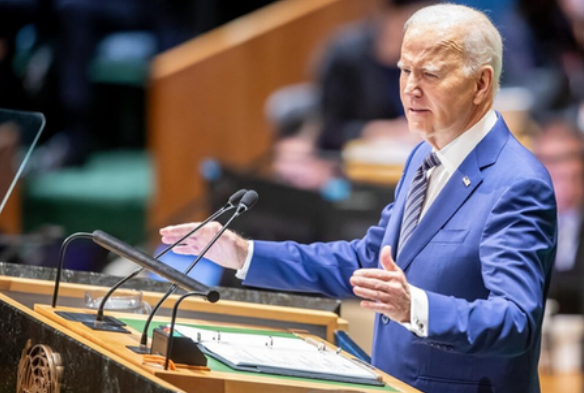

WASHINGTON–Former U.S. President Joe Biden has praised the proposed India-Middle East-Europe Economic Corridor (IMEC) as a major opportunity to strengthen international trade, counter China’s economic influence and deepen cooperation between India and Middle Eastern countries.
In his memoir, “Promise Me, America,” released Tuesday, Biden reflects on the strategic importance of the corridor announced during the September 2023 G20 summit in New Delhi. He also credits the Quad alliance with helping strengthen relations between Washington and New Delhi during his presidency.
“It was brilliant in its simplicity,” Biden writes about the proposed trade corridor.
The initiative envisions a transportation network combining maritime shipping and rail connections to move goods from Mumbai through the Arabian Peninsula and the Middle East to Israel’s port of Haifa. From there, shipments could continue by sea to southern Europe.
“If IMEC could be built, it would not only help us to compete with China,” Biden writes.
Beyond its economic potential, Biden viewed the corridor as a way to encourage closer cooperation among India, Saudi Arabia, other Gulf nations, Jordan, the West Bank and Israel.
“The conversations around IMEC had a remarkable effect. They allowed for the possibility of a new economic and political alignment to emerge,” he writes.
“It involved many nations, but at the heart of it was a profoundly important new relationship between Saudi Arabia and Israel.”
Biden says efforts to improve relations between Saudi Arabia and Israel had been a priority since his July 2022 visit to Israel, the West Bank and Saudi Arabia.
The memorandum signed in September 2023 established the framework for two interconnected trade corridors linking India with the Gulf region and the Gulf with Europe.
The proposal includes rail and maritime transportation infrastructure, electricity and digital connectivity networks, and facilities to support clean hydrogen transportation. The agreement outlined political commitments among participating countries but did not create legally binding obligations.
Biden also identifies the Quad, comprising the United States, India, Japan and Australia, as an important component of his administration’s Indo-Pacific strategy.
He recalls convening a virtual Quad summit in March 2021 with Indian Prime Minister Narendra Modi, then-Australian Prime Minister Scott Morrison and then-Japanese Prime Minister Yoshihide Suga.
“A favourable dividend was a rapidly improving relationship with India,” Biden writes.
He describes strengthening ties with India as a long-standing personal priority dating back to his years in the U.S. Senate.
“I had paid close attention to this relationship for decades, going back to my Senate days, and I was proud to shepherd a US-India nuclear agreement through the Senate in 2006.”
“That had lifted the relationship to a higher level, and I fully intended to lift it some more.”
Biden’s reference concerns the Hyde Act of 2006, which established the legal foundation for civilian nuclear cooperation between the two countries. Congress subsequently approved the bilateral nuclear agreement in 2008, with Biden supporting both measures.
The former president also highlights cooperation on COVID-19 vaccines as an example of how the Quad helped strengthen relationships among its members.
During the March 2021 summit, the four countries announced an initiative that included U.S. financing to help Indian pharmaceutical manufacturer Biological E expand its capacity to produce at least 1 billion vaccine doses by the end of 2022.
The target represented planned manufacturing capacity rather than the number of doses actually delivered.
The Quad leaders subsequently held their first in-person summit in Washington on September 24, 2021.
Biden argues that despite Washington’s historical relationship with Pakistan, the United States had compelling strategic reasons to pursue closer cooperation with India.
He points to the expansion of Indian immigration to the United States following the Immigration and Nationality Act of 1965 and growing scientific collaboration between the countries.
Among the examples he cites is the NASA-ISRO Synthetic Aperture Radar (NISAR) satellite, a joint space mission involving the United States and India.
Biden also places India within a broader network of American partners whose combined economic and technological capabilities provide significant advantages in Washington’s competition with Beijing.
However, he cautions against viewing competition between the United States and China as an inevitable path toward confrontation.
Reflecting on his meeting with Chinese President Xi Jinping in San Francisco, Biden emphasizes that both countries have a shared interest in maintaining communication and avoiding conflict.
“If we continue to defend our values and interests, while working with capable allies, we can build a future big enough for all of us to live in,” he writes. (Source: IANS)