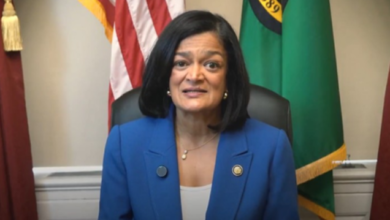
Congressman-Elect Amish Shah Calls for Tariff Rollbacks, Action Against Anti-Indian Hate


WASHINGTON–Congressman-elect Amish Shah of Arizona has called for rolling back tariffs, restoring congressional control over trade policy and addressing rising anti-Indian hostility, outlining his priorities ahead of taking office in the U.S. House of Representatives.
Speaking to Indian reporters on Wednesday, Shah said reducing costs for American families and businesses would be a central focus of his work in Congress. He also pledged to join the Congressional India Caucus and strengthen economic and strategic ties between the United States and India.
“Rolling back those tariffs, reasserting Congress’ authority over tariffs and taking it away from the White House will be a top priority as well,” Shah said.
The Indian American Democrat said business owners in his district had expressed frustration over changing tariff policies, which he argued were increasing costs and creating uncertainty for small businesses.
“We want to help all the small businesses, including all the ones in my district,” he said.
Shah cited a conversation with the owner of Pizza Heaven, a restaurant he regularly visits, to illustrate the financial pressures facing local businesses. The owner told him before Election Day that rising tomato prices were forcing her to increase menu prices because of the cost of pizza sauce.
He pointed to the example as evidence of the broader affordability challenges facing households and businesses, which he linked in part to tariffs.
On U.S.-India relations, Shah described the two countries as important economic and strategic partners with shared democratic traditions. He argued that resolving trade disputes would help strengthen bilateral cooperation.
Although international trade will be among his priorities, Shah said his immediate focus would remain on the concerns of Arizona residents, particularly the cost of living, healthcare and water availability.
“Those are the priorities that we were sent here to fix for the American people, and those are gonna be our top priorities,” he said.
Shah also raised concerns about what he described as a troubling increase in anti-Indian hostility across the United States over the past six months to a year.
He said the rhetoric was particularly painful for Indian Americans, who have contributed to the country through entrepreneurship, medicine and other professions.
Shah expressed concern that some of the hostility had come from individuals seeking public office, underscoring the responsibility of political leaders to challenge discriminatory rhetoric.
Recalling incidents involving students who faced hostile comments while cheering for their football team, Shah said he could identify with their experiences as a former student at Northwestern University.
He called on elected officials to publicly condemn anti-Indian hate, support affected communities and consider legislation to strengthen protections against harassment and violence.
“Nobody should have to feel unsafe when they go to a place to worship,” Shah said.
Healthcare reform is another priority for the incoming lawmaker. Shah expressed support for establishing a public insurance option that would allow Americans to purchase coverage through Medicare.
He argued that expanding access to Medicare on a voluntary basis could increase competition in the insurance market, reduce premiums and improve the program’s financial stability.
“It is their choice to buy in. And I believe it would lower healthcare premiums,” he said.
Shah also emphasized his willingness to work with Republican lawmakers, pointing to his experience serving in Arizona’s state legislature, where he worked to advance legislation despite Republican control.
“I have pledged to work in a bipartisan fashion, just like I did in the State House,” he said.
On foreign policy, Shah called for Congress to reclaim its constitutional authority over decisions involving military conflicts, particularly the ongoing war involving Iran.
He advocated ending the conflict while preventing Iran from obtaining nuclear weapons and addressing the impact of higher fuel prices on American consumers.
Shah, whose family traces its roots to Gujarat, also reflected on his Indian heritage and his family’s immigration journey.
He said his mother moved to Bombay, now Mumbai, as a child, while his paternal grandfather relocated to Cochin, now Kochi, where he established a tea and spices business. Shah visited both cities during his childhood.
His mother later received sponsorship to study at the Milwaukee School of Engineering, arriving in the United States in 1969.
Shah described that opportunity as an example of the generosity that helped shape his family’s American experience and ultimately made his own political career possible.
As he prepares to enter Congress, Shah said he intends to combine his focus on affordability and healthcare with efforts to strengthen U.S.-India relations, support small businesses and confront discrimination against Indian Americans. (Source: IANS)