India-US Trade Deal Will Protect Farmers and Sensitive Sectors, Says Piyush Goyal
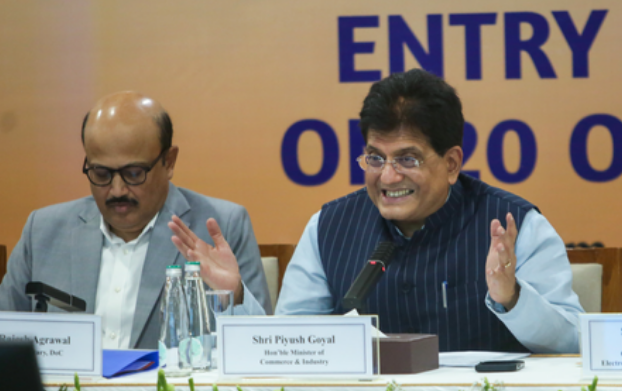

NEW DELHI– India’s Commerce and Industry Minister Piyush Goyal said Thursday that ongoing trade negotiations with the United States would protect the interests of Indian farmers and other sensitive sectors while strengthening the country’s competitive position in international markets.
Goyal expressed confidence that once the details of the proposed India-US trade agreement become public, Indian citizens would recognize that the government had safeguarded key domestic interests while negotiating greater economic opportunities.
Speaking at the Fourth National Conference on India’s Industrial Transformation, organized by the Institute for Studies in Industrial Development (ISID) and the Industrial Development Research Association (IDRA), Goyal emphasized that international trade agreements must balance economic competitiveness with the protection of vulnerable industries.
He said trade negotiations should be evaluated through the principles of comparative advantage and competitiveness rather than focusing exclusively on tariff rates or absolute trade figures.
Goyal noted that several developed economies maintain high import duties on labor-intensive products, using those tariffs as bargaining tools during international trade negotiations.
His remarks come as India and the United States continue discussions on a bilateral trade agreement aimed at expanding commercial ties between the two major economies.
According to an official statement, Goyal said India’s approach to trade negotiations extends beyond traditional agreements focused primarily on tariff reductions, rules of origin and market access.
Instead, the government is pursuing broader economic partnerships designed to promote exports, protect sensitive domestic industries and facilitate access to advanced technologies essential for India’s industrial development.
These include graphics processing units (GPUs), memory technology, medical equipment and other sophisticated products needed to support the country’s manufacturing and technology sectors.
Goyal said India’s trade agreements increasingly incorporate cooperation in services, investment, education, workforce development and technology partnerships.
The negotiations also address environmental priorities, including climate commitments and countries’ nationally determined contributions under international climate agreements.
He emphasized that such comprehensive partnerships are intended to deepen India’s integration into the global economy without exposing vulnerable sectors to excessive international competition.
According to Goyal, the government conducts extensive consultations with industry representatives and other stakeholders before finalizing trade agreements to ensure that domestic economic interests are adequately protected.
The minister also highlighted a significant expansion in India’s trade relationships with developed and relatively prosperous economies.
He said India’s current trade agreements cover 38 countries, creating opportunities for mutually beneficial commercial relationships in which India exports products demanded by partner nations while importing technologies and goods required for its own development.
Goyal pointed to nine free trade and bilateral trade agreements concluded by the government, which he said have opened preferential market access to economies with a combined gross domestic product of approximately $60 trillion.
By comparison, trade agreements concluded before 2014 covered economies with a combined GDP of about $10 trillion, he said.
The minister argued that India’s earlier trade agreements were largely concentrated on countries competing in similar industries, while the government’s current strategy emphasizes partnerships with economies that offer complementary strengths.
Such relationships, he said, could help Indian manufacturers gain access to larger consumer markets while strengthening domestic production capabilities through technology transfers and advanced imports.
Goyal also outlined the priorities needed to accelerate India’s industrial transformation, identifying product quality, economies of scale, international market access and inclusive economic growth as essential elements of the country’s manufacturing strategy.
He called for stronger cooperation among government agencies, private businesses, universities and research institutions to encourage innovation and improve industrial competitiveness.
The minister emphasized that India must move beyond expanding production volumes and focus on establishing itself as a globally recognized manufacturing center capable of competing on quality, efficiency and technological sophistication.
He linked those objectives to the government’s Viksit Bharat 2047 vision, which aims to transform India into a developed nation by the centenary of its independence.
Goyal said achieving that ambition would require coordinated efforts across industry, academia, research organizations and government institutions, supported by trade policies that encourage investment and provide Indian businesses with opportunities in global markets.
His comments reinforced the government’s position that the proposed India-US trade agreement should deliver economic benefits without compromising the interests of farmers and other stakeholders considered particularly vulnerable to changes in international trade policy. (Source: IANS)