Reimagined Ramleela: An Incredible Play with Local Actors, Selfies and Glasses
At Regis College, a community theater production brings the Ramayana to life, revives childhood memories, and reminds us why ancient stories never grow old.

By Upendra Mishra
WESTON, Mass. — Sometimes, the best way to judge a play is not to look at the stage but to listen to the audience.
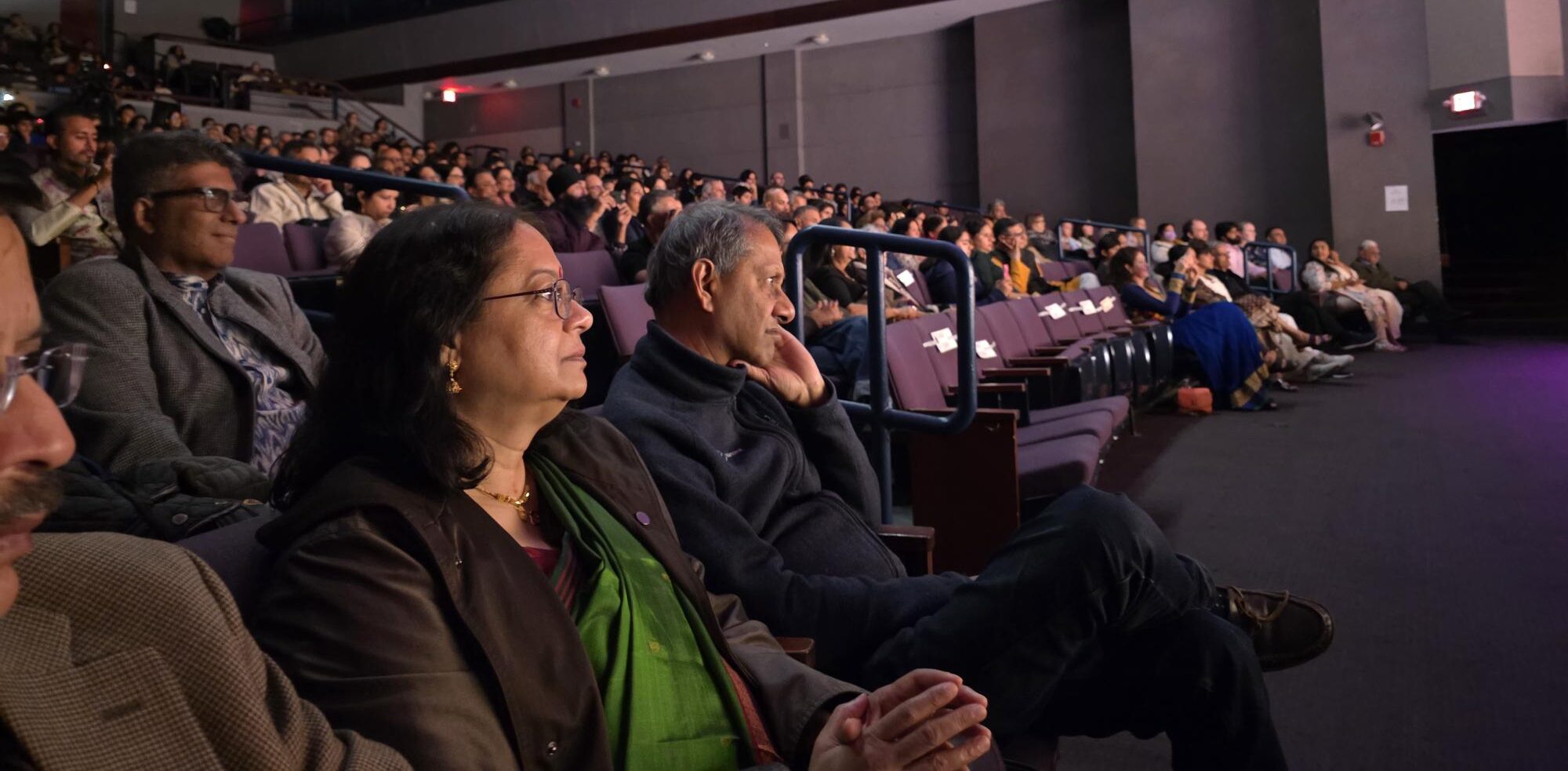
When Ramleela – Reimagined began at Regis College on Sunday, October 18, the auditorium settled into an almost complete silence. There were occasional cries from a few toddlers, understandable in a family-friendly production where children were not merely welcome but part of the intended audience. Otherwise, people watched, listened, and followed the unfolding story with remarkable attention.
There was silence when the story demanded it, applause at the right moments, and an unmistakable sense of engagement. The audience seemed to mirror the performance, responding not just to what was happening onstage but to the emotions and ideas beneath it.
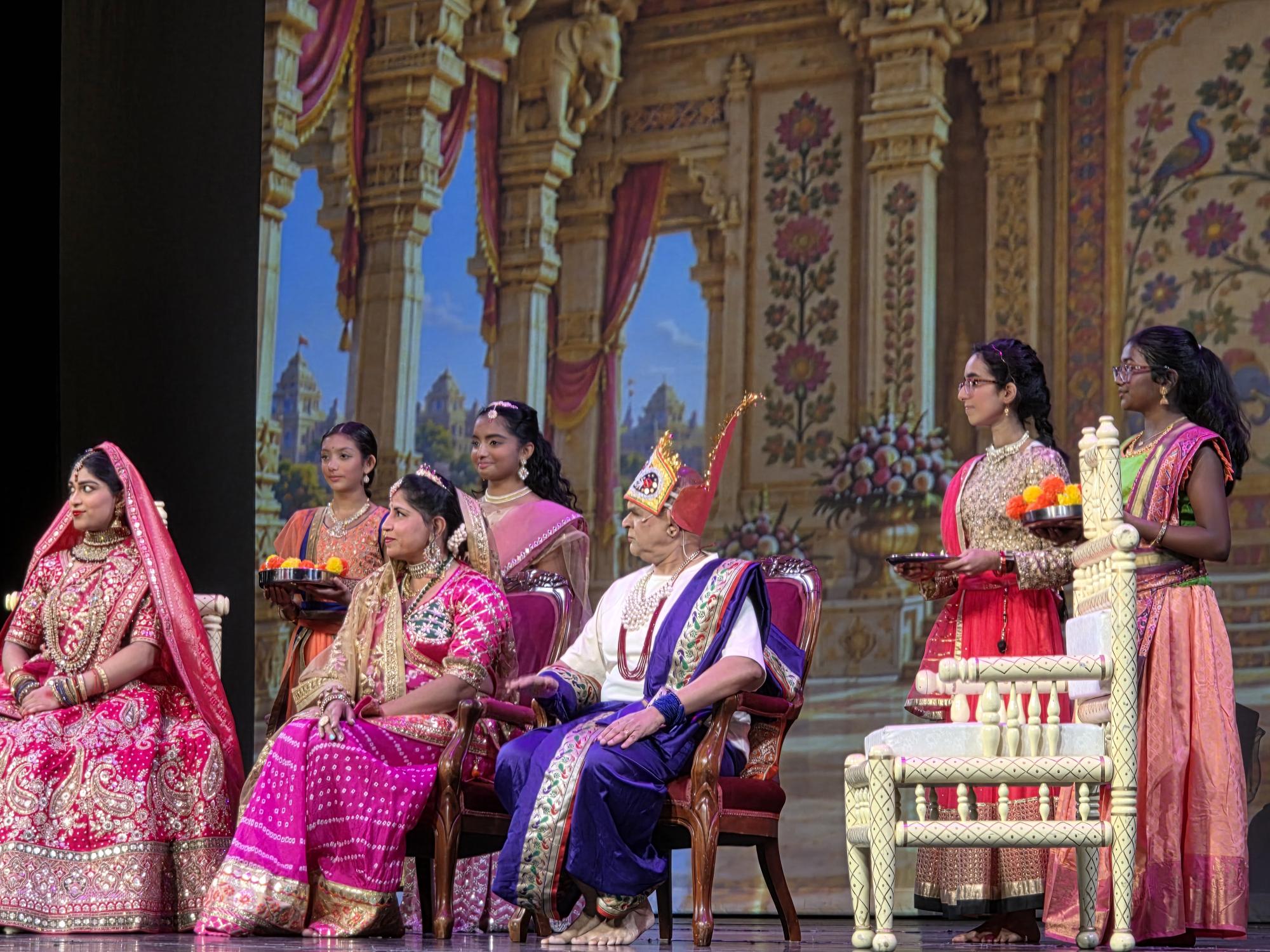 About 450 people attended the production, brought to life by approximately 45 actors. For a community theater effort featuring local performers, that combination of participation and audience engagement was an achievement in itself.
But what stayed with me after the performance was not simply how well the play held the audience’s attention. It was how a familiar story, one that has traveled across generations, could still surprise me, bring back memories of my childhood in India, and make me look at a familiar episode from a slightly different perspective.
That, perhaps, is the enduring magic of mythology.
The stories that never grow old
Mythology never really dies. Generation after generation reads these stories, hears them from parents and grandparents, and passes them on to children and grandchildren. We may know the characters, anticipate the twists, and remember the endings. Yet each retelling offers an opportunity to discover something new.
The Ramayana is particularly rich in this respect. It is a story of duty, love, loyalty, ambition, sacrifice, and the consequences of our choices. It speaks of an ancient world, but its moral questions remain remarkably relevant.
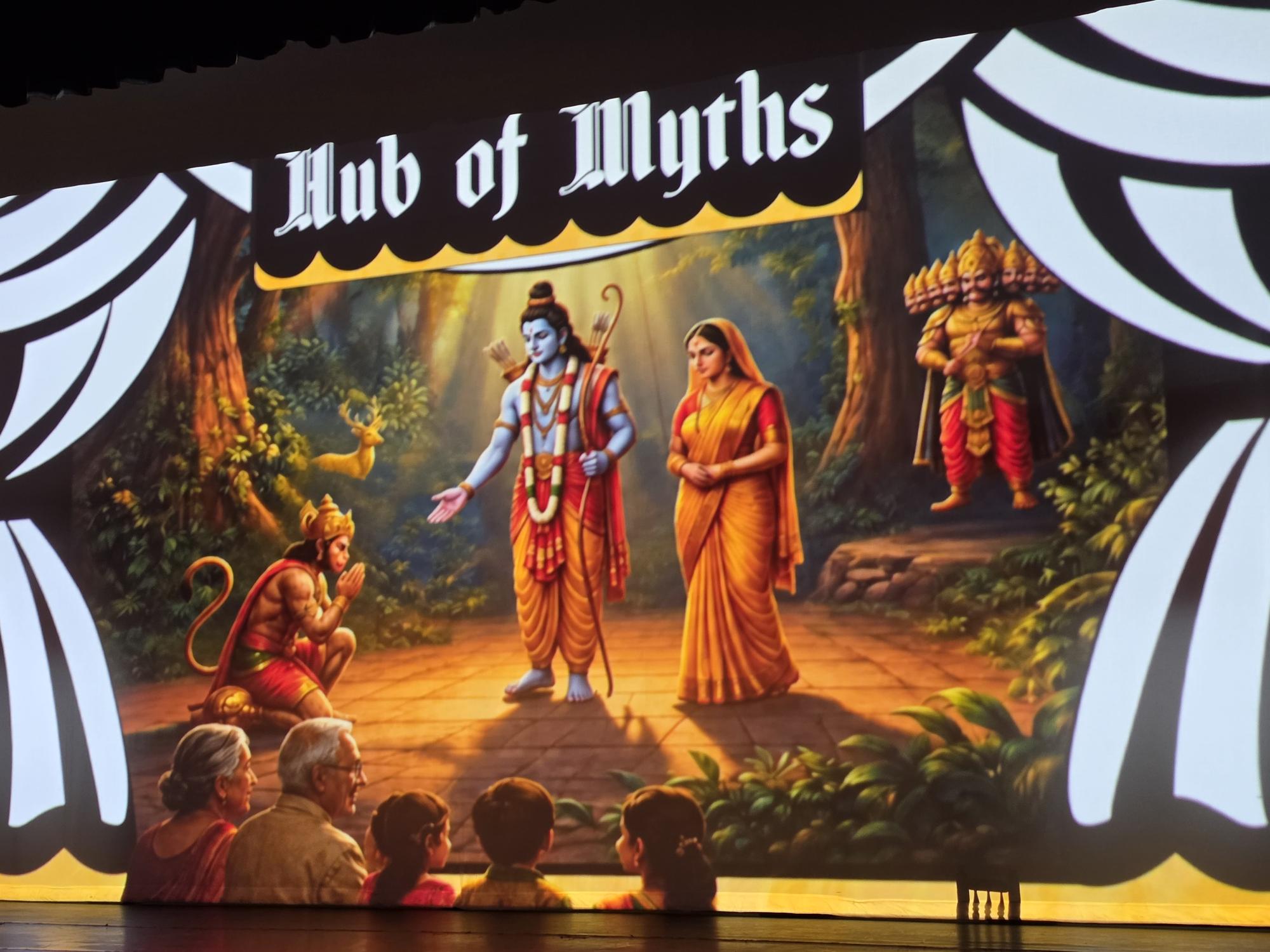
Directed by Bhavna Patel Shah and Sakshi Sibal, Ramleela – Reimagined, the second production by the New England community theater group Hub of Myths, approaches this familiar epic with an accessible theatrical device.
The play opens not in the world of ancient Ayodhya, but in a modern family setting. Grandparents and children begin asking questions about Diwali and the Ramayana. Nana and Nani take on the role of storytellers, explaining the epic to the younger generation. Their conversation then gives way to scenes from the Ramayana itself. From time to time, the family returns to the stage, reconnecting the ancient narrative with the present-day world.
I thought this was a particularly effective choice.
For children born and raised in the United States, especially those who may not have grown up hearing the Ramayana at home, the story can sometimes feel distant or unfamiliar. The grandparents provide a natural bridge between generations, helping young viewers understand not only what happens in the epic but also why its characters and lessons continue to matter.
The device also gives the audience a familiar point of entry. Rather than asking everyone to step immediately into an ancient world, the play begins with a family conversation many viewers can recognize.
From there, the story unfolds through a series of clear, accessible episodes. The directors have selected and presented the narrative in a way that allows the audience to follow the action without getting lost in the epic’s many characters and subplots.
The timeless contrasts between good and evil, dharma and adharma, and the consequences of our decisions emerge naturally from the storytelling.
When mythology meets selfies and spectacles
The word reimagined was not merely part of the production’s title. It showed up in some delightfully unexpected ways.
At one point during Sita’s swayamvar, as the princes prepared to lift the mighty dhanusha—the bow—one of them stopped to take a selfie first.
I couldn’t help smiling. Even in the world of ancient kings, royal princes, and legendary feats of strength, apparently, the perfect photo opportunity could not be ignored! One could almost imagine a prince thinking that lifting the bow was important, but capturing the moment for posterity was equally essential.
And then there were the eyeglasses.
Here were actors dressed in costumes that transported us thousands of years into the past, inhabiting the world of Ayodhya and its neighboring kingdoms, while some were also wearing very contemporary-looking spectacles. I found myself laughing and wondering: Did people in the age of Rama wear glasses, too? Had I missed a chapter of the Ramayana?
Of course, the spectacles were a practical reality of actors performing today, rather than a historical statement. But that contrast was part of the charm. The selfie brought a familiar modern habit into an ancient royal gathering, while the glasses offered a gentle reminder that the people bringing these larger-than-life characters to the stage were members of our own community.
These moments did not take away from the epic. Instead, they added a lighthearted contemporary touch, making the production feel approachable without losing sight of the story it was telling. The audience could appreciate the grandeur of the Ramayana and, at the same time, enjoy a little humor at the intersection of ancient mythology and modern life.
Perhaps that is one way to reimagine a timeless story: preserve its spirit, introduce a few unexpected surprises, and give the audience something to smile about along the way.
A small detail that made me think
One moment particularly caught my attention, not because it was dramatic, but because it made me question my own understanding of the story.
In the scene involving King Dasharatha’s desire for an heir, the king first turns to Kaikeyi, his second wife, as he discusses the possibility of having children. I found myself wondering whether this was a mistake. My understanding of royal protocol had led me to expect that the eldest queen, Kaushalya, would be approached first.
I initially questioned the sequence.
But as the story continued, I began to see a possible connection.
The queens eventually give birth to four sons: Rama to Kaushalya, Bharata to Kaikeyi, and Lakshmana and Shatrughna to Sumitra. Later, when Dasharatha announces his intention to crown Rama as the crown prince, Kaikeyi’s maid Manthara approaches her and questions why her own son Bharata should not receive the throne.
Manthara’s intervention becomes a turning point in the story.
Looking back at the earlier scene, I wondered whether Dasharatha’s special affection for Kaikeyi was being subtly established from the beginning. Perhaps his decision to approach her first was intended to foreshadow the emotional dynamics that would later influence the course of events.
I cannot say whether this connection was deliberately planned by the directors. But the possibility made me appreciate how a small detail in a familiar story can acquire new meaning when viewed alongside what follows.
It was a reminder that watching a play is not a passive experience. Sometimes, the audience member becomes a participant in the act of interpretation, connecting moments, questioning assumptions, and discovering personal meanings along the way.
Local actors, extraordinary commitment
One of the most appealing aspects of Ramleela – Reimagined was the cast.
Approximately 45 actors came together for this production. They were not presenting themselves as professional theater stars. They were community members who had taken on the demanding task of bringing a major mythological narrative to the stage. Yet the performances demonstrated commitment, confidence, and a clear understanding of the characters they were portraying.
The child actors deserve particular appreciation. Their presence helped make the production feel like a shared community experience rather than simply a performance for an audience.
Among the characters, I especially enjoyed Shurpanakha. Even within the limits of the production’s storytelling, her portrayal left an impression. Ravana was compelling, while Rama, Lakshmana, and Sita provided the central figures around whom the familiar drama unfolds. Shabari and Manthara, though appearing more briefly, also made their moments count. And Hanuman was wonderful, and his humility and strength and his decision to remove and fear and doubt from his mind and focus on the task at hand is so relevant today everywhere–whether on a personal journey or corporate America.
The production’s sound and audiovisual elements worked well, helping the audience follow the story. I also noticed how the performers’ shadows appeared on the screen behind them. Whether an intentional visual choice or a happy coincidence of the staging, the effect felt natural and added another dimension to the live action.
These details matter in community theater. A production does not need elaborate sets or a professional company’s resources to hold an audience. It needs a clear vision, committed performers, and the ability to make people care about what they are watching.
Hub of Myths, through its second production, demonstrated the value of bringing people together around a shared creative undertaking.
A journey back to my childhood
For me, the experience carried another layer of meaning.
As I watched the play, I found myself remembering my childhood in a village in India, where local villagers would stage Ramleelas and other plays. These were community affairs, brought to life by people who might not have had formal theatrical training but who understood the stories, cared about their characters, and wanted to share them with others.
The resources might have been modest, but the enthusiasm was real. The performances were part of the social and cultural fabric of the community.
Watching Ramleela – Reimagined brought some of those memories back.
There was something deeply reassuring about seeing a similar spirit at work thousands of miles away, in New England. The setting had changed, the audience was different, and the performers were building their own theatrical experience. Yet the underlying impulse felt familiar: people coming together to tell a story that belongs to more than any one individual.
This is perhaps one of the most important contributions of community theater. It creates opportunities for people to participate in culture rather than simply consume it. A person can become an actor, help with costumes, build a set, coordinate a performance, or support the production behind the scenes. In the process, a story becomes a collective achievement.
For families raising children in the United States, such productions can also provide a living connection to cultural traditions. Children do not have to encounter the Ramayana only through books, family conversations, or religious celebrations. They can see its characters embodied onstage, hear the dialogue, experience the drama, and begin asking their own questions.
And those questions are worth encouraging. Traditions remain alive not because every generation receives them unchanged, but because each generation finds its own reasons to engage with them.
An ancient epic, a living community
Ramleela – Reimagined may be a volunteer-driven amateur theater production, but its value cannot be measured solely by professional theatrical standards. Its achievement lies in bringing together accessible storytelling, community participation, and an epic whose themes continue to resonate across generations.
The near-silence of an audience of about 450 people told me that the production had succeeded in holding people’s attention. The applause reflected their appreciation. And the memories and questions I carried away reminded me that the experience had done something more personal: it had connected the story I was watching with the stories I had grown up with.
Perhaps that is what a successful reimagining should do. It should respect the familiar without making it feel predictable. It should invite newcomers without alienating those who already know the story. And it should leave room for the audience to discover something of its own.
As I left, I was reminded that the Ramayana does not belong only to the past. It lives wherever people continue to tell it, question it, perform it, and pass it on.
Sometimes, all it takes is a stage, 45 committed local actors, and an audience willing to listen.
And sometimes, an old story can make us feel that we have discovered it all over again.