Indian American Philanthropy — Part 1: A Community’s Growing Generosity
How values, identity, and a commitment to giving are shaping the next chapter of Indian American philanthropy

(Editor’s Note: Indian Americans have built a remarkable legacy of achievement in the United States. Yet beyond professional success and economic prosperity lies another important story: a growing commitment to philanthropy, community, and giving back. In this three-part series, we present Indian American Philanthropy: Strengthening Values and Community Across Generations, an article originally published by The Bridgespan Group in collaboration with the Ford Foundation. Drawing on interviews with more than 60 donors, nonprofit leaders, and experts, the article explores the motivations, experiences, and aspirations shaping Indian American philanthropy. In Part 1, we explore the growth of Indian American giving and the values, family experiences, and professional journeys that inspire donors to make a difference in the United States and India. The original article is reproduced with permission. Its content has been retained, with editorial headlines and notes added to guide readers through this series.)
By: Rohit Menezes, Isaiah Baker, Bradley Seeman
Recognizing the relevance and potential of Indian American philanthropy, our Bridgespan team, in partnership with the Ford Foundation, sought to learn more about the Indian American diaspora’s giving and explore how to increase its momentum. In addition to examining available data, we interviewed more than 60 donors, nonprofit leaders, and other experts, listening to the voices, experiences, and ideas of a wide range of people who are intimately familiar with the community.
Conversations with Indian Americans about their community’s place in the United States often follow a familiar arc—a recitation of extraordinary achievement.
Prosperity frequently comes up: in 2023, Indian Americans reported a median annual household income of $151,200, nearly double the US median of $80,610.1 So, too, does professional prominence: community members lead many of the largest US-based tech companies,2 account for as many as 10 percent of America’s doctors,3 and own more than 50 percent of its small- and mid-sized hotels and motels.4
For a relatively new immigrant community—now 5.2 million members, up from only 360,000 in 19805—these achievements are worthy of pride. But underneath the triumphal narrative lies a more complex story about how Indian Americans are grappling with identity and belonging in the United States.i
Immigrants to the United States from across the globe strive to carry their culture forward and sustain core ideals while adapting to new environments and building new relationships. Like other communities with familial ties to other nations, Indian Americans routinely negotiate how they and their families fit into American life while honoring their traditions and staying connected to their roots in India. Recently, this negotiation has been complicated by charged public discourse about immigrants6 in the United States.
Giving can be a powerful vehicle for this negotiation, and Indian American giving is on the rise. The available data are clear: Indian Americans are civically engaged and generous. There is a vast cadre of volunteers, donors, and advocates who embrace generosity and showcase what matters to them along the way.
“Are Indian Americans generous?” says Meena Lakdawalla-Flynn, chair of Global Private Wealth Management at Goldman Sachs. “I would say that Indian Americans are among the most generous communities I have worked with.”
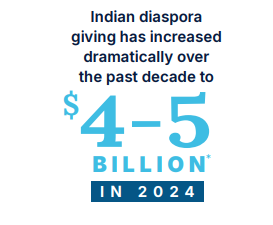
Indian Americans volunteer at three times the national average in the United States and have substantially increased their philanthropic giving over the past several years. A joint report on Indian American diaspora philanthropy7 by Indiaspora, Dalberg, and the India Philanthropy Alliance found that diaspora giving has increased dramatically over the past decade to $4–5 billion in 2024. The increase is partly due to a rise in Indian Americans’ median income, but mainly because a much higher share of donor household income is being given away— rising from an estimated 1–2 percent in 2018 to 4–5 percent in 2024.
(i By “Indian American,” we are referring to the Indian diaspora residing in the United States, regardless of citizenship. * Source: Dalberg, Indiaspora, and the India Philanthropy Alliance, From Closing the Gap to Setting the Standard: The State of Philanthropic Giving in the Indian American Diaspora, 2026.)
 In our interviews, we found Indian American donors giving in a wide variety of ways. Consider the example of Sapna Saxena, co-founder of Neel Capital Management, who also runs the Saxena Family Foundation. Like many diaspora donors, Saxena gives in both the United States and India, and has found creative ways to link the two. At The Coolidge Corner Theatre, a nonprofit cinema she supports in the Boston area, she underwrote a series featuring Indian films titled “Cinema Masala.” “It’s giving people an opportunity to connect with a part of Indian culture. Locally, 1,500 tickets were sold, with multiple screenings selling out entirely. It doesn’t always need to be big numbers or make a big splash. You can start small.”
The Saxena family also expresses gratitude toward India—where Saxena’s parents benefited from education at the Indian Institute of Technology and Delhi University—with substantial gifts to organizations such as Akshaya Patra and Ashoka University. “My parents made clear that they can only do what they do now in large part thanks to their education. As long as my parents and I are around, money will always be focused on education in India because of respect for my parents and for where we come from,” says Saxena.
A belief in education is an important theme in Indian American giving, not only to institutions in India but also to those in the United States. Indiaspora, a network of global leaders of Indian origin, estimates that Indian Americans have given over $3 billion to higher education in the United States since 2008.8
When the Indian American community talks about its giving, the potential for even greater impact is unmistakable. Growing in numbers and wealth, the community is on the verge of a significant intergenerational wealth transfer. Indian Americans are orienting their philanthropy toward both where they live and where their families came from.
“The United States is where my bread is buttered. It’s the country of my children and grandchildren. We are committed to contributing our skills and resources here,” says Shekar Narasimhan, who built a career in finance after moving to the United States in the 1970s. Narasimhan is involved in a variety of US causes—among other things, he is chair and cofounder of the AAPI Victory Fund, which promotes Asian American, Native Hawaiian, and Pacific Islander candidates for elected office.
“My parents made clear that they can only do what they do now in large part thanks to their education. As long as my parents and I are around, money will always be focused on education in India because of respect for my parents and for where we come from.”
–SAPNA SAXENA, CO-FOUNDER, NEEL CAPITAL MANAGEMENT
At the same time, the potential of the Indian American diaspora to have a major impact in India has never been greater. A report from Give Grants identified an opportunity for the Indian American diaspora to give in ways that create significant impact for India’s most vulnerable citizens around such goals as climate action, gender equity, food security, and economic growth.9 Indeed, several studies and reports over the past several years attest to the potential impact of diaspora giving in India.10
Many of the donors in our most recent interviews see India as having a mature, vibrant social sector—allowing their funding to make a real difference. And private funding can do things that government or corporate social responsibility (CSR) funding rarely can—for example, helping NGOs serve as R&D hubs that pave the way for larger-scale government funding.11 As India seeks to transform itself into a fully developed, self-reliant country by its anniversary celebrating 100 years of independence in 2047, giving from the Indian American diaspora could make a powerful and distinctive difference in contributing to India’s nation-building goals by giving to institutions, causes, or communities that are under-supported by domestic philanthropy and CSR funding.
We believe Indian American philanthropy, both in the United States and to India, will continue to be shaped and reinforced by three powerful currents described by many of those we interviewed—expressing values and interests, building community, and strengthening connections across generations. We explore those three themes below: (Expressing Values and Interests, Building Community, and Engaging Across Generations.) We conclude by exploring opportunities to overcome the challenges that are holding back giving.
1 Expressing Values and Interests
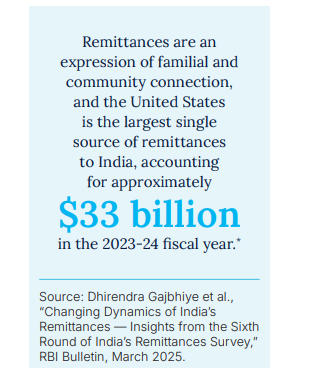
Values are at the core of all kinds of giving. For Indian Americans, one example is remittances— funds that flow from US residents to their relatives, friends, and associates in India. Remittances are an expression of familial and community connection and the United States is the largest single source of remittances to India,12 accounting for approximately $33 billion in the 2023-24 fiscal year, according to the Reserve Bank of India. Members of the Indian American diaspora also demonstrate their commitment to faith traditions with their giving—as evidenced by thousands of temples, mosques, gurudwaras, and other institutions across the United States.
In our interviews, we saw how larger-scale Indian American philanthropy is also shaped by the values and interests that inform donors’ worldviews. One of the most consistent themes we heard was the importance of parents and other family members in shaping diaspora givers’ approach to their philanthropy.
Rashi Mehta, for example, cofounded and played a central role in growing a technology company into a global operation before selling it. Now she is channeling a combination of management skills, time, and financial resources toward philanthropy both in the United States and India. Her foundation is called the Iron Lady Foundation—named in honor of her mother, who was one of the first female gynecologists in the state of Rajasthan and used her position to provide free services to women and girls in rural districts. “I never saw my mother back down,” says Mehta. She remembers visiting those villages as a youth and observing how women and girls had “sparks in their eyes” even as the surrounding society sometimes treated them as a burden.
 Today, Mehta’s philanthropy focuses on girls’ education and women’s empowerment. Every few months, the foundation’s work takes Mehta back to rural India, where she spends time with nonprofit staff and community members. The work is informed by what she learned from her mother and from her own life experience. “When women and girls are given access to opportunity, they create lasting change within their families and communities.”
We also spoke with donors whose values and interests have been shaped not only by their roots in India but also by their experiences building companies in the United States. They proudly embrace their identities as entrepreneurs, even when they turn to philanthropy. They are eager to get their hands dirty, bringing the grit and resolve required to build a successful venture.
Consider Deepak Chopra (no relation to the famous author), who lives part-time in California and is the founder and CEO of Freedom Employability Academy (FEA), which offers a program in north India’s Hindi belt for youth to build employability skills, including English, digital and AI literacy, and personal skills like self-confidence and communication. “I’m an entrepreneur,” explains Chopra. “We may not be the brightest people in the room, but we’re hardwired for persistence.”
Chopra launched his philanthropic efforts concurrently with for-profit ventures; he has founded or cofounded multiple companies. Beginning in 1999, Chopra started spending half his time on his philanthropic work. He credits his overall success to the balance between his for-profit and philanthropic focus: “Working on FEA helped me be a more patient, kind person. My business experience made me more efficient and helped me understand the importance of talent development.”
Like any committed entrepreneur, Chopra is focused on results. An impact evaluation by Stanford researchers found that by completing a one-year FEA program, a student, on average, will add enough to their career earnings to move from low income to middle income. Graduates earn over $55,000 more over the course of their careers than their peers who do not participate. Chopra invests about $18 million per year in FEA’s program. This support helps FEA provide a 500-plus-hour program to approximately 100,000 students per year at physical training centers. FEA has already served over 800,000 students.
Professional identities, as entrepreneurs or otherwise, inform the philanthropy of many other givers whom we spoke to. Vidya Prakash was a management consultant at McKinsey & Company’s Global Public Health Practice, where she grew to appreciate the power of business approaches to improve the efficiency and effectiveness of nonprofit organizations. Now a volunteer and a donor supporting gender equality in the United States, India, and elsewhere, Prakash seeks to bring her professional expertise to bear in her philanthropy. “There’s so much you can do to help organizations improve their effectiveness, like board governance or monitoring and evaluation.”
Among other activities, Prakash facilitates a session every two months with the CEOs of several Indian nonprofits. “Often there’s no set agenda. We vent, we problem-solve, we explore patterns and learnings across organizations. It’s a safe space for frank conversations.” Some of these organizations Prakash supports with funding, others with expertise alone.
Other givers choose to anchor less in their families and professional identities and more in how they believe lasting positive change can be achieved. California resident BU Patel and his family have built significant wealth through the hospitality industry and a diversified investment portfolio. Patel’s formal philanthropic journey took shape in response to a devastating earthquake in the family’s home state of Gujarat in 2001. Watching the aftermath, Patel noted that the most effective responses were coming from within the communities experiencing the challenges, not from outsiders, and that relying on deep local knowledge could yield greater results.
That “aha” moment about trusting local communities to lead their own change has increasingly animated the family’s giving via the Tarsadia Foundation. For example, the foundation has directed a $10 million five-year grant to the Rebuild India Fund. This collaborative vehicle is supported by Dasra, a leading Indian philanthropic intermediary and systems orchestrator that works to coordinate actors in the social sector. Rebuild India provides flexible, multiyear funding to grassroots organizations serving some of the most marginalized and overlooked communities across India. A core principle of the fund is the trust it places in grantees to use the funding as the organizations themselves see fit, which dovetails with the Tarsadia Foundation’s belief in the importance of local knowledge and community power.
“There’s so much you can do to help organizations improve their effectiveness, like board governance or monitoring and evaluation.”
-VIDYA PRAKASH, FORMER MANAGEMENT CONSULTANT, CURRENT VOLUNTEER AND DONOR FOR GENDER EQUALITY
Stay tuned for Part-2: Building Community Through Giving
(Note: Footnotes will be added in the final part-3.)