Bangladesh’s U.S. Trade, Defense Deals Could Hurt Economy, Report Says
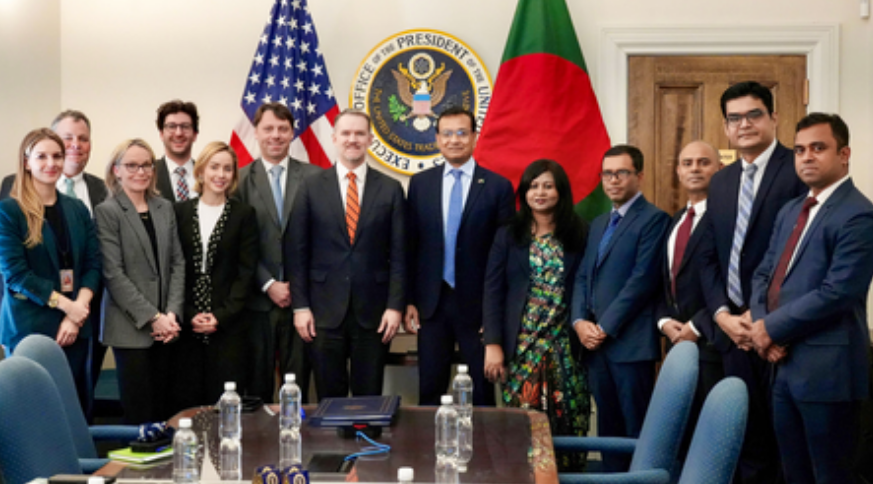

NEW DELHI — Bangladesh’s recent trade and defense dealings with the United States could leave the country more economically dependent on Washington and expose its garment, aviation and defense sectors to long-term financial risks, according to an article in Bangladeshi media.
The article, published in Dhaka’s The Daily Star, argued that the U.S.-Bangladesh trade arrangement “mirrors colonial economics much in the same way that the British exploited India during the pre-Independence era.”
According to the article, the deal with the Trump administration allows Bangladeshi garment exports to enter the U.S. market at zero duty, but requires the goods to be produced using cotton and fiber imported from the United States.
The article said that condition could make Bangladesh’s garment industry increasingly dependent on U.S. cotton production, agricultural subsidies, market priorities and pricing. Any shift in U.S. policy or supply conditions could directly affect Bangladeshi factories, workers and bank loans, it said.
Moshahida Sultana, an associate professor at Dhaka University, wrote that the arrangement resembles earlier colonial-era trade patterns, in which India was turned into a supplier of raw materials and a captive market for finished goods.
The article said agreements that offer zero duty while requiring the use of U.S. cotton could tie Bangladesh’s largest export sector to the upstream supply chains of American agricultural and corporate interests.
It also raised concerns over defense procurement, saying modern trade and defense agreements can create pressure to buy more American surveillance systems, communications equipment and precision munitions.
The article said such pressure may be framed diplomatically, but the message is often clear: avoid suppliers from Russia and China. Over time, it argued, Bangladesh’s defense purchases could be pushed toward a single U.S.-based ecosystem involving American platforms, ammunition, software, encryption systems and spare parts, all subject to U.S. export licenses.
“Publicly, it is about ‘maritime security’ and ‘threat response’. But the budget books reveal the old colonial logic in a modern uniform: a dependent state’s foreign-exchange reserves used to secure profits for foreign arms companies. The louder the talk of ‘shared security’, the more money drains from Dhaka into distant corporate headquarters,” the article said.
The article also warned that large aircraft purchases from Boeing could create debt risks for Bangladesh, particularly if the planes are not aligned with the country’s actual aviation needs.
It said aircraft deals may be presented as investments in “advanced aviation” and “a modern fleet,” but are priced in dollars, often financed through long-term loans or leases, and tied to American parts, software, maintenance and training.
The article noted that Bangladesh’s imports of aircraft engines from the United States have already increased from Tk 137 crore to Tk 1,852 crore. It said that if passenger forecasts prove inaccurate or the national airline faces inefficiency or corruption, loan repayments would continue, placing the burden on the public and draining foreign-currency reserves.
For a debt-burdened economy, the article said, such arrangements could become “a recipe for a debt trap.” (Source: IANS)