
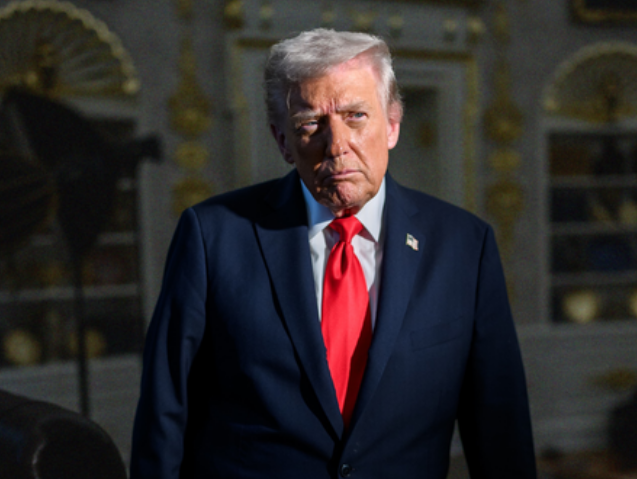

NEW YORK, N.Y. — President Donald Trump marked the start of his second year in office by pressing an aggressive foreign policy agenda that threatens to upend the international strategic order, testing long-standing alliances such as NATO while signaling a more accommodating posture toward Russia.
In a series of early-morning posts on Truth Social, Trump emphasized U.S. power and renewed expansive territorial rhetoric. “The United States of America is the most powerful Country anywhere on the Globe, by far,” he wrote, reiterating claims to Greenland and issuing veiled references to reviving past designs on Canada.
The remarks drew a sharp response from French President Emmanuel Macron, who accused Trump of seeking to “weaken and subordinate” Europe. Macron warned that the European Union could consider retaliatory measures against the United States, even if such steps might seem “crazy.”
“I do regret that, but this is a consequence of just unpredictability and useless aggressivity,” Macron said, referring to what is informally known as the EU’s “Bazooka Option,” a mechanism that would impose sweeping tariffs and other economic and political sanctions on countries deemed to be coercing EU members.
Such a move could deal a serious blow to the trans-Atlantic alliance, whose core is the North Atlantic Treaty Organization, which has underpinned Western security for more than seven decades.
Further straining NATO, Trump invited Russian President Vladimir Putin to join a proposed Peace Council, a body Trump initially floated as part of a framework to end the Gaza conflict and oversee reconstruction. He has since suggested expanding the council’s remit to broader global issues and has even floated the idea of a $1 billion permanent membership, positioning it as a potential alternative to the United Nations.
As tensions mounted, Trump prepared to travel to Davos, Switzerland, for the World Economic Forum, where he was expected to encounter several leaders opposed to his Greenland proposal. “I agreed to a meeting of the various parties in Davos, Switzerland,” Trump wrote on Truth Social, adding, “Greenland is imperative for National and World Security. There can be no going back.”
He underscored the point by posting an image of himself planting a U.S. flag on Greenland and another image from the Oval Office showing a map that included Greenland, Venezuela, and Canada as part of an expanded United States.
Public opinion at home appears firmly opposed to such moves. According to a CBS News poll, 86 percent of Americans oppose a military takeover of Greenland, and 70 percent oppose annexation outright.
Trump also escalated trade threats, warning France of a 200 percent tariff on wine and Champagne after reports that Macron was considering boycotting the Peace Council because of Russia’s potential participation. The warning followed Trump’s announcement of 10 percent tariffs on France and seven other countries opposing his Greenland plan, with a possible increase to 25 percent in June.
Despite the confrontational tone, Trump struck a more conciliatory note toward NATO Secretary-General Mark Rutte, describing a recent phone call as “good” and sharing a message from Rutte that read, “I am committed to finding a way forward on Greenland.” The exchange highlighted the alliance’s internal dilemma over how to respond to Trump’s approach.
In other posts, Trump mocked a message from Macron proposing a G7 meeting in Paris after Davos, with Denmark, Syria, Ukraine, and Russia participating on the sidelines. Macron’s message included the line, “Let us try to build great things,” and referenced possible discussions on Iran and Syria.
Trump also took aim at British Prime Minister Keir Starmer over the status of Diego Garcia, following Britain’s decision to return sovereignty of the island to Mauritius while maintaining a lease for U.S. and British military bases. In a separate message to Norwegian Prime Minister Jonas Gahr Store, Trump said that not receiving the Nobel Peace Prize had made him give up on peace.
The dispute over Greenland has also cast a shadow over efforts to end the war in Ukraine. Trump campaigned in 2024 on a promise to end the conflict within 24 hours of taking office, but more than a year later, the war continues despite his alternating signals of support for Kyiv and Moscow and a summit with Putin.
Ukraine and several Western European nations have recently proposed a plan to end the conflict that they say addresses Russia’s concerns, though Moscow has maintained a hardline stance. The Greenland controversy has complicated those efforts, potentially strengthening Russia’s leverage as NATO unity frays.
At home, Trump faces strong opposition to Greenland annexation as domestic concerns such as inflation, affordability, and divisions over immigration dominate the political landscape ahead of crucial midterm elections that could determine control of Congress.
Trump’s unfavorable rating stands at 53.6 percent in the RealClearPolitics aggregation, reflecting a negative spread of 10.4 percentage points.
Some analysts suggest Trump may attempt to frame a Greenland takeover as a fait accompli during a year when the United States marks the 250th anniversary of its independence, betting that a surge of patriotic sentiment could blunt domestic and international resistance. (Source: IANS)