India’s decisions will shape Indo-Pacific future, top U.S. official says
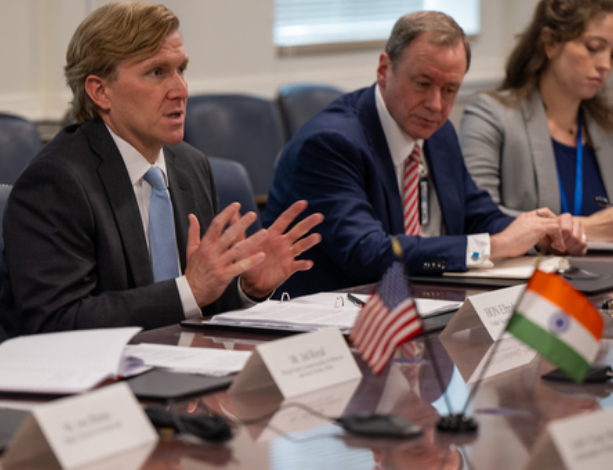
NEW DELHI — A senior U.S. defense official said Tuesday that India’s strategic choices will play a decisive role in shaping the future of the Indo-Pacific, underscoring Washington’s view of New Delhi as an essential partner in maintaining regional stability.
Elbridge Colby, U.S. Under Secretary of Defense for Policy, said the United States holds India in “deep respect” as a major democratic power with a strong strategic tradition and growing global influence.
“The United States views India with deep respect — as a republic of continental scale, as a nation with a proud strategic tradition, and as a country whose decisions will profoundly shape the future of the Indo-Pacific and the international landscape more broadly,” Colby said during a session at the Ananta Centre.
Colby is visiting India to meet senior officials and advance bilateral defense ties, which Washington sees as critical to maintaining a favorable balance of power in Asia.
He said the U.S. considers India not just a key partner but an essential one, citing its geographic position and expanding capabilities.
“India’s importance stems not only from its size and economic potential, but also from its geography and strategic position. Your country sits astride the Indian Ocean, which is the connective tissue of the Indo-Pacific,” he said.
Colby also pointed to India’s tradition of strategic autonomy and its ability to influence events beyond its borders, as well as its military strength.
“It is the largest republic in the world; its success thus carries profound symbolic and political weight. And it has formidable, self-reliant, and capable military forces, willing and able to shoulder significant security responsibilities,” he said.
Describing India’s role as indispensable, Colby said the U.S. approach to the partnership is grounded in realism and shared interests rather than idealism.
“We clearly recognize that India has its own interests, its own strategic culture, and its own priorities, and that India is not shy about advancing them,” he said, adding that the two countries’ outlooks are closely aligned.
Referring to India’s foreign policy framework, he noted that External Affairs Minister S. Jaishankar has described the country’s approach as “Bharat First” and “the India Way.”
“Like America First and flexible realism, Bharat First and the India Way emphasize the centrality of a realistic approach to foreign policy, an unabashed willingness to put one’s own national priorities first, and a results-oriented mindset about international politics,” Colby said.
He also highlighted a recent defense agreement signed between U.S. Defense Secretary Pete Hegseth and Indian Defense Minister Rajnath Singh, calling it a strong foundation for future cooperation.
“Our focus must now be on advancing forward from these important agreements to serve a larger strategic purpose: strengthening the ability of both countries to contribute to a stable balance of power in this vital region,” he said. (Source: IANS)