India on Brink of Naxal-Free Status as Maoist Leadership Collapses, Amit Shah Says
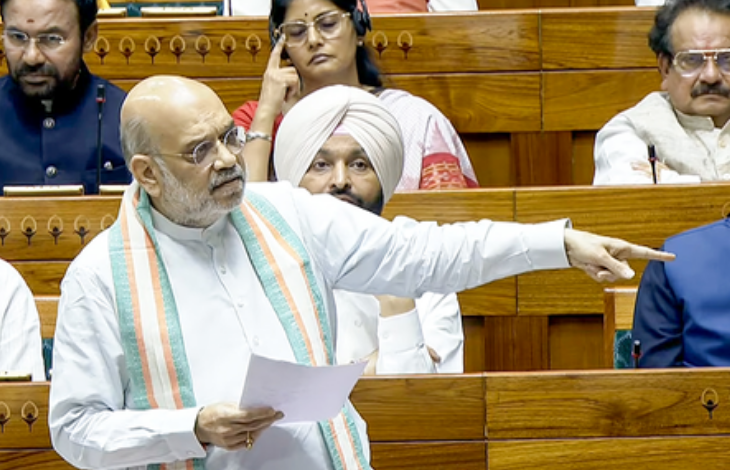

NEW DELHI — India has nearly eliminated left-wing extremism, with Maoist leadership structures across the country largely dismantled, Union Home Minister Amit Shah told the Lok Sabha on Monday, a day before the government’s March 31 deadline to eradicate Naxalism.
Speaking during a debate on the issue, Shah said the central and state leadership of Maoist groups has been “neutralized or forced to surrender,” marking what he described as a major milestone under the government’s zero-tolerance approach.
“Out of the top leadership, 12 have been killed, and only one is absconding, with talks underway for his surrender as well,” Shah said.
He added that state-level leadership networks have also been severely weakened. In one key affected state, a 27-member committee has effectively been wiped out, with 11 members killed and discussions ongoing with two others. In Madhya Pradesh and the Maharashtra-Chhattisgarh region, three committee members have surrendered, leaving only three active. In Odisha, one member surrendered and three were killed. In Telangana, three leaders were eliminated, leaving no remaining members of the State Military Commission.
Shah outlined broader gains over the past three years, stating that 4,839 Maoists have surrendered, 2,218 have been arrested, and 706 have been killed in encounters.
He said the government has consistently encouraged insurgents to surrender and join the mainstream, but warned that those who continue to attack security forces and civilians would face forceful action.
“We have always kept the doors open for dialogue and rehabilitation, but those who fire bullets at security forces, tribals, farmers, and children will be answered in the same language,” Shah said.
The home minister credited the progress to a coordinated strategy that combines security operations, development programs, and the use of technology. He cited several major operations, including Operation Octopus in Jharkhand’s Gumla, Lohardaga, and Latehar districts, Operation Thunderstorm in Jharkhand, and Operation Chakra in Bihar.
He also highlighted a 21-day operation along the Telangana-Chhattisgarh border, where security forces dismantled a major Maoist base on a strategic hill. The camp, he said, had enough supplies to sustain 400 to 500 cadres for up to five years.
Praising the efforts of security personnel, Shah commended the Central Reserve Police Force, COBRA units, District Reserve Guards, and state police, particularly in the Bastar region, which he said has undergone significant transformation.
“Bastar, once synonymous with red terror, is now witnessing rapid development,” he said, pointing to improvements in infrastructure, access to food distribution, Aadhaar enrollment, and basic services in remote villages.
Shah also criticized previous governments, accusing them of neglecting tribal regions and allowing Maoist groups to gain influence.
“The truth is that development was denied to Bastar because of red terror,” he said, adding that since 2014, welfare programs have expanded to include housing, cooking gas, drinking water, insurance, and food security in Naxal-affected areas.
With Maoist networks largely dismantled and only a minimal presence remaining, Shah said India is on the verge of officially declaring itself free from Naxalism.
He told lawmakers that once final procedures are completed, the country will formally mark the end of a decades-long insurgency. (Source: IANS)