
Dalai Lama Wins First Grammy, Highlights Shared Universal Responsibility
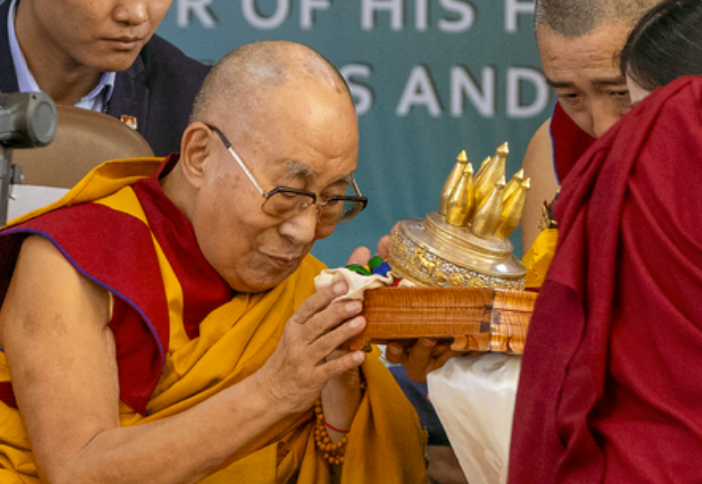

DHARAMSHALA, Himachal Pradesh — The Dalai Lama has won his first Grammy Award, receiving the honor for Best Audio Book, Narration, and Storytelling Recording, with the Tibetan spiritual leader saying the recognition reflects a shared responsibility toward humanity rather than a personal achievement.
The 90-year-old Nobel Peace Laureate earned the award for “Meditations: The Reflections Of His Holiness The Dalai Lama,” an audio project featuring collages of his reflections on mindfulness, harmony, health, and compassion, captured over recent years and set alongside innovative musical collaborations with Hindustani classical influences.
The Dalai Lama competed in the category against Fab Morvan of Milli Vanilli, U.S. Supreme Court Justice Ketanji Brown Jackson, television host Trevor Noah, and actress Kathy Garver. Musician Rufus Wainwright accepted the award on his behalf during the ceremony, which was streamed on YouTube.
Responding to the honor, the Dalai Lama said, “I receive this recognition with gratitude and humility. I don’t see it as something personal, but as a recognition of our shared universal responsibility. I truly believe that peace, compassion, care for our environment, and an understanding of the oneness of humanity are essential for the collective well-being of all eight billion human beings.”
“I’m grateful that this Grammy recognition can help spread these messages more widely,” he added.
The award comes more than six decades after the Dalai Lama fled Tibet into exile. In March 1959, following the crushing of an uprising by Chinese forces, Tenzin Gyatso, the 14th Dalai Lama, escaped Tibet disguised as a soldier after a perilous 14-day journey. He entered India on March 17, 1959, accompanied by a small retinue of soldiers and cabinet ministers.
After arriving in India, he initially lived for about a year in Mussoorie, Uttarakhand, before settling in Dharamsala in 1960. The hill town in Himachal Pradesh has since become the seat of the Tibetan government-in-exile and the center of his efforts to promote human values, religious harmony, and the preservation of Tibetan language and culture, rooted in the traditions of India’s Nalanda University.
Reflecting on life in exile, the Dalai Lama had said on March 10, 1960, just before moving to Dharamsala: “For those of us in exile, I said that our priority must be resettlement and the continuity of our cultural traditions. We, Tibetans, would eventually prevail in regaining freedom for Tibet.”
In his recent book, “In Voice for the Voiceless,” the Dalai Lama offers insights into his decades-long engagement with China and revisits Tibet’s unresolved struggle for freedom. The book traces his extraordinary life, including the loss of his homeland, the challenges of leading a nation in exile, and his vision for the future of the Tibetan people.
He was 16 years old when Communist China invaded Tibet in 1950, 19 when he first met Chairman Mao in Beijing, and 25 when he was forced to flee to India and assume leadership in exile.
India is currently home to an estimated 100,000 Tibetans, along with the Tibetan government-in-exile. (Source: IANS)