Beyond What They Cannot See: The Samarthanam Sisters Find Their Voice, Their Dreams and Their Stage: Part-1
In a Face-to-Face conversation with INDIA New England News, visually impaired singers Anusha and Vasundhara speak about growing up without seeing their blindness as a limitation, discovering music, pursuing their dreams and building lives defined by possibility rather than disability.
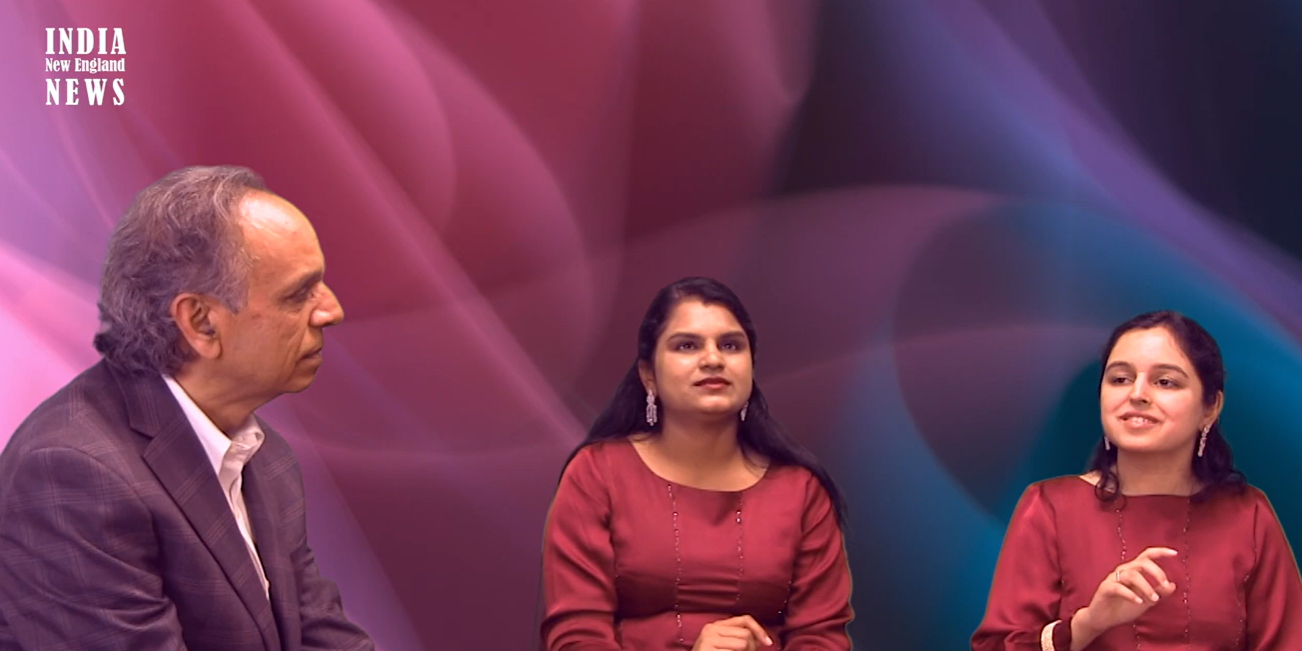

BOSTON–For Anusha and Vasundhara, music is not simply a profession. It is a way of seeing the world.
The sisters, known professionally as the Samarthanam Sisters, have built a musical partnership rooted in Hindustani classical music, while also performing devotional, semi-classical, folk and contemporary songs in several languages. Both are visually impaired. But that fact, they make clear, is not the defining feature of who they are.
In a recent Face-to-Face interview with INDIA New England News, the sisters spoke candidly about their childhoods, the moment they came to understand their visual impairment, their musical journeys, their dreams and the resilience that has shaped their lives.
To watch part-1 of the full conversation with Anusha and Vasundhara in Face-to-Face on INDIA New England News, please click here.
What emerges is not a conventional story about overcoming disability. Instead, it is a story about two young women who, for much of their childhood, simply understood their world differently—and gradually learned to navigate it without allowing that difference to determine the boundaries of their ambitions.
The sisters were launched as a musical duo in 2025 and have since taken their music to audiences in India and abroad. Their work is supported by Samarthanam Trust for the Disabled, an organization founded in 1997 that focuses on education, livelihood, rehabilitation, sports, arts and other opportunities for people with disabilities and underserved communities.
‘We thought it was normal’
One of the most revealing parts of the sisters’ conversation is the way they describe discovering their own visual impairment.
As children, they did not necessarily see themselves as different from everyone else. Their understanding of blindness developed gradually, as they encountered situations in which they could not do what others could.
That early perspective appears to have remained important to the sisters’ outlook. Rather than beginning with a sense that something was missing, their journeys began with an assumption that they, too, could learn, participate and pursue the things that interested them.
That attitude is reflected in the way they talk about disability today.
They do not frame blindness as the central obstacle in their lives. Instead, they speak about training, opportunity, hard work and the determination to pursue their interests.
Music became a language of possibility
For Anusha, that path led deeply into Hindustani classical music.
She trained in the Jaipur Gharana tradition under Vidushi Vijaya Jadhav Gatlewar at the Dr. Gangubai Hangal Gurukul in Hubballi and later completed a master’s degree in Hindustani music. She now serves as principal of Samarthanam’s Institute of Music and Performing Arts. Her performance experience includes Indian and international cultural platforms, including UNESCO and other major events.
Vasundhara developed her own musical identity and gained national attention through the television music competition Sa Re Ga Ma Pa Li’l Champs. She has continued to develop her Hindustani classical foundation while performing across genres and platforms.
Together, the sisters bring those different experiences to their performances.
Their repertoire spans classical, devotional, folk and contemporary music, allowing them to move between traditional compositions and more familiar popular songs. The Samarthanam Sisters’ official profile describes their work as multilingual and multi-genre, with music serving as a vehicle for inclusion and empowerment.
Dreams bigger than the stage
Their ambitions also extend beyond performing.
The sisters have used their music to support causes connected to disability inclusion. During their international performances, they have helped raise awareness and funds for the USA Women’s Blind Cricket Team, including efforts connected to the Women’s T20 World Cup Cricket for the Blind.
That connection is particularly meaningful because Samarthanam has long been involved in blind cricket through the Cricket Association for the Blind in India.
The sisters’ work therefore sits at an intersection of music, representation and social change. Their performances give audiences an opportunity to hear their artistry, but also to reconsider assumptions about what visually impaired artists can accomplish.
A different definition of resilience
There is an easy temptation to describe stories like theirs as stories of people who “overcame” disability.
The sisters offer something more nuanced.
Their story is less about overcoming blindness than refusing to let blindness become the measure of their potential.
They have had to learn different ways of navigating the world. They have faced practical challenges. They have worked hard to develop their musical abilities. But their conversation repeatedly returns to dreams—what they want to accomplish, where they want to go and what they want their music to mean.
That may be the most powerful element of their story.
The Samarthanam Sisters are not asking audiences to look past their blindness and see their music. They are showing that both can exist together: they are visually impaired women, accomplished musicians, students and teachers, performers and dreamers.
And when they step onto a stage, their primary language is not disability.
It is music.