India Invokes 1943 Bengal Famine at UN, Warns of Ukraine War’s Impact on Global Food Security

UNITED NATIONS– India has warned that disruptions to global food supplies caused by the war in Ukraine could have devastating consequences for developing nations, drawing parallels with the 1943 Bengal famine that killed millions of people.
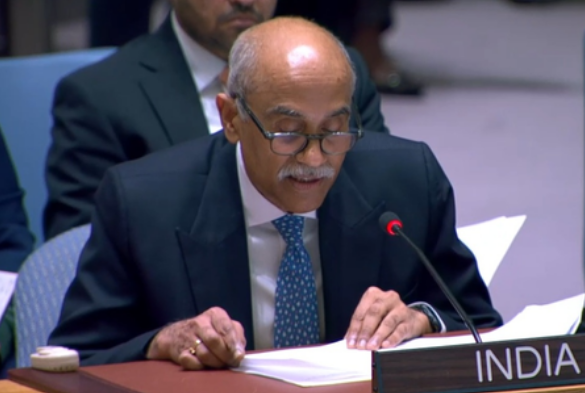
Speaking at the United Nations Security Council on Monday, India’s Permanent Representative P. Harish highlighted the importance of Russian and Ukrainian agricultural exports to global food security and warned that disruptions to production, maritime transportation and international trade could have far-reaching consequences.
“The pain and suffering caused by the devastating Bengal famine of 1943 in India that killed over three million people in India, is a stark reminder of the terrible human cost of a distant conflict caused by unchecked wartime priorities and calculations”, he said.
Harish compared the current food security challenges to the suffering experienced by populations during World War II that had no direct involvement in the conflict.
“This current situation is not different from the time of the Second World War, when peoples not responsible for the start of the conflict became their unintended collateral damage”, he said.
Reiterating Prime Minister Narendra Modi’s position on the need for peace, Harish emphasized that developing nations continue to bear a disproportionate share of the economic and humanitarian consequences of global conflicts.
“For the Global South, peace is not in the abstract. It is achieved when hungry mouths are fed”, he said.
Harish made the remarks during a Security Council discussion on protecting critical energy infrastructure and Black Sea shipping routes essential to global food supplies.
World Food Programme Executive Director Luke Lindberg warned that approximately 10 million metric tons of Russian and Ukrainian wheat, enough to feed an estimated 44 million people, have been blocked amid the escalating conflict.
Lindberg identified Somalia as being at risk of famine and highlighted the increasingly difficult situation facing Yemen, which imports 90 percent of its food.
The 1943 Bengal famine occurred during World War II, when British colonial wartime policies, including the diversion of food supplies and destruction of grain stockpiles, contributed to widespread starvation.
Harish said disruptions to agricultural supplies have compounded energy shortages and rising costs that have disproportionately affected developing economies.
“India has consistently emphasised that the causes of conflict are not shared equally. Global South countries are the most adversely affected by the food, fuel and fertiliser crisis caused by today’s global conflicts”, he said.
UN Under-Secretary-General Rosemary DiCarlo also expressed concern about the broader consequences of the war, particularly threats to commercial shipping and agricultural exports through the Black Sea.
“In the Black Sea, drone attacks continue to threaten civilian navigation. The consequences extend far beyond the region, disrupting grain exports and other foodstuffs to countries in need”, she said.
Harish urged the Security Council to prioritize humanitarian access, protect civilian infrastructure, safeguard humanitarian supplies and ensure freedom of navigation.
He also emphasized the importance of India and the Black Sea region to international food security, noting that together they account for nearly one-fifth of global cereal production. (Source: IANS)