India Offers to Help Restore Black Sea Grain Exports as Modi, Zelensky Discuss Ukraine Peace Efforts
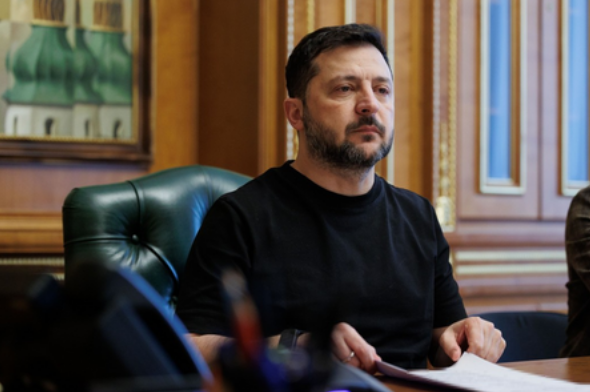

KYIV–India has expressed its willingness to help establish food export corridors in the Black Sea as part of broader diplomatic efforts to address the war between Russia and Ukraine, Ukrainian President Volodymyr Zelensky said following a telephone conversation with Prime Minister Narendra Modi on Monday.
The two leaders discussed ongoing peace initiatives, preparations for diplomatic talks in Abu Dhabi and potential measures to restore grain shipments disrupted by the conflict.
According to a statement from the Ukrainian President’s Office, Zelensky briefed Modi on recent diplomatic developments and emphasized Ukraine’s willingness to pursue negotiations aimed at ending the war.
“The Head of State spoke about the situation in diplomacy. Ukraine is actively preparing for each of the issues on the agenda of the meeting in Abu Dhabi. The President emphasised that Ukraine always has a constructive approach, and the same willingness to de-escalate from Russia is needed,” the statement said.
Zelensky acknowledged Modi’s repeated calls for an end to the conflict and encouraged India to use its diplomatic relationships to advance peace efforts.
“The Prime Minister has repeatedly said, including to the Russian leader, that now is the time to end the war, not continue it. It is important that India finds what steps it can take and dialogue with other leaders to help bring the end of the war closer,” Zelensky noted, according to the statement.
Food security emerged as a central topic during the conversation, particularly the disruption of grain exports through the Black Sea.
Ukraine said India had indicated its readiness to mediate efforts to establish food corridors that would allow agricultural shipments to reach international markets.
Zelensky emphasized that restrictions on maritime trade have consequences extending well beyond Ukraine and Russia, particularly for countries that depend on grain imports.
“Russia must understand that its economy and hundreds of millions of people in different countries suffer from blocked sea routes,” Zelensky said.
Both leaders agreed that officials from their respective governments would remain in contact regarding food security, diplomatic initiatives and other bilateral matters.
India’s Prime Minister’s Office confirmed the conversation and reiterated New Delhi’s longstanding position that the conflict should be resolved through negotiations.
“Prime Minister reaffirmed India’s human-centric approach and reiterated India’s consistent position that the conflict must be resolved through dialogue and diplomacy. He conveyed India’s readiness to contribute to all efforts aimed at peaceful resolution of the conflict,” the PMO said.
The two leaders also reviewed opportunities to expand cooperation between India and Ukraine across several sectors.
“The two leaders also discussed measures to further strengthen India-Ukraine bilateral cooperation in various sectors for the mutual benefit of the two peoples,” the PMO added.
The conversation follows diplomatic outreach by India involving Russia, Ukraine, European governments and the United States.
Earlier this month, External Affairs Minister S. Jaishankar said India had been pursuing discussions on three areas related to the conflict: protecting civilian shipping and maritime workers, restoring grain exports through the Black Sea and reducing attacks on energy infrastructure.
Speaking to Indian journalists on the sidelines of the G20 Foreign Ministers’ Meeting in Atlanta, Jaishankar outlined New Delhi’s diplomatic efforts.
“We’ve had discussions with Russia. We’ve had discussions with Europe. We’ve had discussions with Ukraine also about three aspects of the current conflict: one, not to attack civilian shipping and seafarers; the second, to find a way by which the grain exports from both Russia and Ukraine… find a way of restoring that flow because that flow has cut down very sharply in the Black Sea, and the third is with regard to energy,” he said.
Jaishankar identified attacks on energy infrastructure as the most difficult issue to address because the parties involved have differing interpretations of what such restrictions should cover.
“Non-attack on energy is probably the most complicated piece because it means different things to the different players,” he said.
“Infrastructure itself to some would mean a refinery. To some it would mean grids. There would be issues relating to ships carrying fuel. So we have been trying to see if we can get them together to address these issues,” Jaishankar added.
He also emphasized the importance of restoring agricultural exports for developing economies, many of which depend on grain shipments originating in the Black Sea region.
Jaishankar described the disruption as “a big concern for the global south because much of the purchasers of that grain are basically global south countries.”
India has maintained diplomatic communication with both Moscow and Kyiv throughout the conflict, including meetings involving Modi, Russian President Vladimir Putin and senior officials from both governments.
Jaishankar said he had personally engaged with Russian Foreign Minister Sergey Lavrov and Ukrainian officials while continuing discussions with European partners.
“Prime Minister himself had, you know, discussion with (Russian) President (Vladimir) Putin in Delhi, and before that in Bishkek. I had gone earlier to Moscow, and we continue even today. I discussed it with (Russian Foreign Minister) Mr. Lavrov, and then in between, I had gone to Kyiv. And we are in touch with the Ukrainian side,” he said.
New Delhi has also coordinated its diplomatic efforts with Washington, which is pursuing its own initiatives to facilitate negotiations.
“We have also been coordinating this with the Americans, because they have their own peace mediation initiative. So Secretary Rubio knows roughly what is going on here,” Jaishankar said.
The latest discussion between Modi and Zelensky signals India’s continued interest in supporting diplomatic measures that could reduce the humanitarian and economic consequences of the war, particularly disruptions to global food supplies. (Source: IANS)