Indian American Women Celebrate Karwa Chauth in Atlanta, Keeping Traditions Alive Far From Home
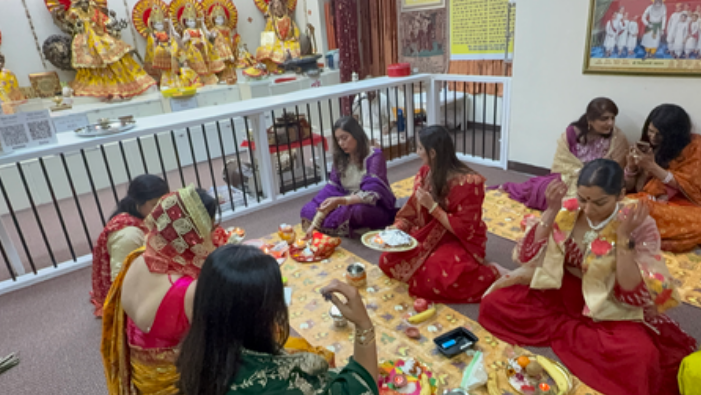

ATLANTA–Dozens of Indian American women gathered at a Hindu temple in Atlanta to celebrate Karwa Chauth, observing traditional prayers, fasting and rituals while strengthening community bonds that help preserve their cultural heritage thousands of miles from India.
Dressed in colorful sarees and traditional outfits, the women assembled at Sadhana Temple with decorated prayer plates, flowers and ceremonial lamps to mark the Hindu festival, which is traditionally observed by married women praying for the longevity and well-being of their husbands.
For many participants, the celebration provided an opportunity to recreate familiar traditions while connecting with friends and other members of the Indian American community.
“I think we try to do very much the same way,” Neha said when asked how the celebrations compared with those in India. “But we do miss the family.”
Jaya, originally from Delhi, said friendships have helped compensate for the absence of relatives during important religious celebrations.
“Yeah. We have friends. So we come together.”
Inside the temple, women sat facing one another on the floor, holding decorated prayer plates containing small burning lamps. Fruits, flowers and ceremonial vessels were arranged before them as they participated in traditional prayers.
Many wore embroidered dupattas covering their heads, colorful bangles and intricate henna designs on their hands. Their traditional clothing ranged from deep red and purple to bright pink and green.
An altar displaying elaborately dressed Hindu deities formed the backdrop for the gathering.
For longtime residents of the United States, Karwa Chauth has become an annual tradition that connects them to their Indian roots.
One participant, who said she had lived in the United States for 30 years, described attending the celebrations at Sadhana Temple every year.
Speaking in Hindi, she explained that the items required for traditional observances are now readily available in the United States, making it easier for Indian American families to maintain their religious and cultural practices.
Other participants said community gatherings have allowed them to observe Karwa Chauth even if they had never celebrated the festival while living in India.
“I think we’re able to come together as a community and still perform all the rituals and traditions,” one woman said.
Another participant praised the temple for organizing the celebration consistently over the years.
“The puja was very well done, as always,” she said. “I’ve come here for 15, 20 years now, and they’ve done always an amazing job.”
While the religious ceremonies remained central to the gathering, participants also shared lighter moments about the traditions associated with the festival, including receiving presents from their husbands.
“All of us are always looking forward to getting good gifts from our husbands,” one woman said, prompting laughter and agreement from others.
The celebration also included women originally from Pakistan, reflecting the cultural traditions shared by communities across South Asia.
For Kiran, a newly married participant, the gathering marked her first Karwa Chauth celebration.
“This is my first time celebrating. I’m a newlywed,” she said.
Her companion, Ashwini, said she was observing the festival for the second time.
Ashwini described Karwa Chauth as an occasion to pray for a husband’s long life while reflecting on the devotion, love and patience associated with the Hindu deities Shiva and Parvati.
Both women spoke about missing their mothers-in-law during the celebration, highlighting the importance of family relationships in traditions that are often passed from one generation to the next.
Karwa Chauth is celebrated primarily by married Hindu women, particularly in northern India. Traditionally, participants observe a daylong fast for their husbands’ health, longevity and well-being.
Preparations typically include applying henna, wearing festive clothing and jewelry, and decorating ceremonial prayer plates.
The evening observance often concludes after the moon rises, when women traditionally view the moon through a sieve, offer prayers and break their fasts.
For Indian American families living far from relatives in India, temple celebrations have become an important way to maintain these customs and introduce them to younger generations.
The Atlanta gathering illustrated how community friendships and shared religious practices continue to keep cultural traditions alive, allowing participants to celebrate familiar festivals while building a sense of home in the United States. (Source: IANS)