Indian American Congressman Ro Khanna Takes Aim at Democratic Leadership, Says He Is ‘Not a Chuck Schumer Democrat’
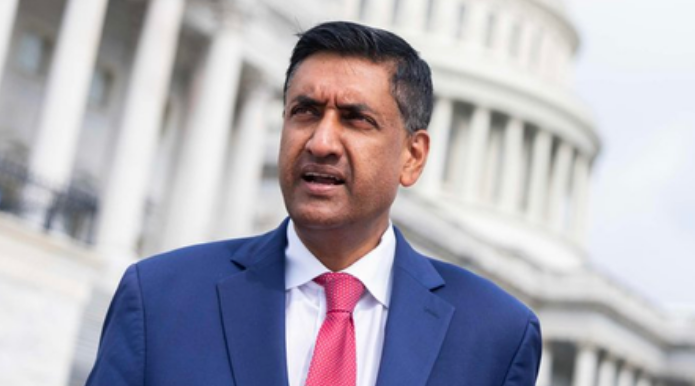

WASHINGTON — Indian American Congressman Ro Khanna has publicly distanced himself from Senate Democratic leader Chuck Schumer, calling for a Democratic Party less influenced by wealthy political donors and more closely aligned with progressive economic policies.
Khanna, a California Democrat, made the remarks Wednesday while campaigning in Florida alongside state Rep. Angie Nixon, a progressive lawmaker, ahead of the November 3 midterm elections.
“I am a New Deal Democrat, not a Chuck Schumer Democrat,” Khanna wrote on X.
“I’m in Florida campaigning with @AngieNixon because we need a Democratic Party that is not beholden to the donor class,” he said.
“That means more Angie Nixons in this party and fewer Chuck Schumers to lead the way forward,” Khanna added.
His comments represent a pointed criticism of the Democratic Party’s established leadership as progressive lawmakers and activists push for changes in the party’s political strategy and economic priorities.
Schumer, who represents New York, serves as the Democratic leader in the U.S. Senate and is among the party’s most prominent national figures.
Khanna did not identify specific policy disagreements with Schumer in his post, which included a 57-second video that had attracted more than 32,000 views by Wednesday evening.
The California congressman, whose district includes parts of Silicon Valley, has increasingly emerged as an outspoken advocate for the party’s progressive and economically populist wing.
He has repeatedly criticized the influence of corporations and major political donors on American politics, arguing that Democrats should place greater emphasis on working-class voters and economic inequality.
By identifying himself as a New Deal Democrat, Khanna invoked the economic philosophy associated with President Franklin D. Roosevelt, whose administration introduced sweeping reforms during the Great Depression of the 1930s.
Roosevelt’s New Deal programs expanded federal investment in public works, established Social Security and strengthened protections for American workers.
Progressive Democrats frequently reference the New Deal when advocating for expanded economic opportunities, stronger labor protections and greater government investment in public services.
Khanna’s criticism comes amid an ongoing debate within the Democratic Party over its future direction following its losses in the 2024 elections.
Several progressive lawmakers and political activists have called for generational change within the party’s leadership and a renewed focus on economic issues affecting middle- and working-class Americans.
Khanna has been traveling to support Democratic candidates in several states ahead of the November 3 congressional midterm elections, seeking to strengthen the party’s progressive representation.
He has also been mentioned as a possible contender for the Democratic presidential nomination in 2028, although he has not announced plans to seek the presidency.
First elected to Congress in 2016, Khanna is one of six Indian American members of the U.S. House of Representatives.
He also serves as co-chair of the Congressional Caucus on India and Indian Americans, which promotes stronger relations between the United States and India and addresses issues affecting the Indian American community.
Earlier this month, Khanna joined calls for a comprehensive investigation by the Justice Department and FBI into an alleged plot to carry out a mass shooting at a Hindu temple in Aurora, Illinois.
The son of Indian immigrants, Khanna has become one of the more visible Indian American voices in national Democratic politics, combining advocacy for stronger U.S.-India relations with a progressive domestic economic agenda.
His latest remarks highlight growing tensions between the Democratic Party’s established leadership and lawmakers seeking a more populist approach as the party prepares for the midterm elections and looks toward the 2028 presidential race. (Source: IANS)