India Must Move From ‘Pharmacy to Laboratory of the World’: Anupriya Patel
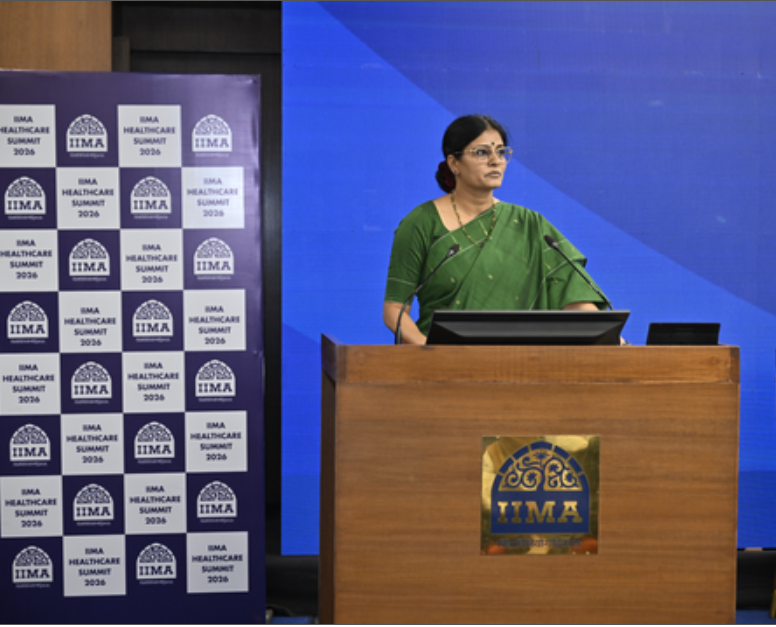

AHMEDABAD— India must move beyond its established role as the “pharmacy of the world” and emerge as the “laboratory of the world” by placing research, innovation and artificial intelligence at the centre of its healthcare ambitions, Minister of State for Health and Family Welfare and Chemicals and Fertilisers Anupriya Patel said on Saturday.
Addressing the third edition of the IIMA Healthcare Summit 2026 at the Indian Institute of Management Ahmedabad (IIMA), Patel said India’s pharmaceutical sector must progress beyond manufacturing medicines and vaccines developed elsewhere and focus increasingly on innovation and drug discovery.
The summit, themed “Advancing AI in Healthcare,” brought together policymakers, healthcare industry representatives and academics to examine how artificial intelligence can contribute to building a healthy and developed India by 2047.
Patel highlighted India’s role during the Covid-19 pandemic, noting that the country’s pharmaceutical industry maintained supplies of vaccines and essential medical products to more than 200 countries, while India’s vaccination programme administered more than 2.2 billion doses.
She said the next phase of India’s healthcare journey must build on that manufacturing strength by making research and innovation central to the country’s pharmaceutical and healthcare ecosystem.
Artificial intelligence, she said, could transform several areas of healthcare, including drug discovery, personalised treatment, disease screening, clinical decision-making and disease surveillance.
At the same time, Patel stressed that AI must be deployed safely and responsibly, with patient privacy and human oversight at the centre of its adoption.
“AI must complement, not replace, human clinical judgement,” she said.
Patel called for AI applications to move beyond pilot projects and be implemented at population scale through greater collaboration among the government, academia, healthcare institutions, startups and industry.
She said Centres of Excellence for AI in healthcare had been established at AIIMS New Delhi, PGIMER Chandigarh and AIIMS Rishikesh.
The Minister also highlighted the government’s Rs 5,000-crore Promotion of Research and Innovation in Pharma-MedTech Sector (PRIP) Scheme, aimed at strengthening research and industry-academia collaboration and supporting a shift towards innovation-led growth.
She also referred to the Rs 10,000-crore Biopharma SHAKTI mission announced in the Union Budget to strengthen capabilities in biologics and biosimilars, develop skilled manpower and enhance regulatory and clinical trial capabilities for India’s domestic biopharmaceutical ecosystem.
Department of Pharmaceuticals Secretary Manoj Joshi said adoption of AI was growing across the pharmaceutical and healthcare sectors.
While large pharmaceutical companies are using AI in areas such as production, human resources, marketing, distribution and inventory management, startups—particularly those based in Bengaluru and Hyderabad—are increasingly applying the technology to drug discovery, he said.
“Startups, particularly those based in Bengaluru and Hyderabad, are using the technology for drug discovery,” Joshi said.
AI can help identify and shortlist potential drug candidates more rapidly, reducing the time required for the drug discovery process, he said.
Joshi identified access to capital, software licensing, computing capacity and specialised talent among the key challenges facing AI-driven innovation.
“The government is working to address these constraints through initiatives, including the National Biopharma Mission and IndiaAI Mission, and is also working towards providing substantial support to eligible startups for software licensing and operational costs,” he said.
Joshi also stressed the need to make healthcare and genetic data accessible to Indian innovators while maintaining appropriate safeguards.
He highlighted the potential of AI in clinical trials, precision medicine and the digitisation of patient-level healthcare data.
Health and Family Welfare Secretary Punya Salila Srivastava said the Union government was working to develop a robust digital health ecosystem and promote responsible, evidence-based use of AI.
“The Ayushman Bharat Digital Mission (ABDM) is creating an interoperable, open-standards-based digital health ecosystem, with more than 96 crore ABHA IDs and over 1,000 crore health records digitally linked across healthcare facilities and professionals,” she said.
Srivastava also highlighted AI-enabled applications for the early detection of diseases such as tuberculosis and diabetic retinopathy, as well as AI-enabled clinical decision support through eSanjeevani, which has benefited more than 20 crore patients.
She stressed the importance of privacy, responsible AI, evidence-based innovation and collaboration among government, academia, startups and industry.
She also pointed to the IndiaAI Mission and AIKosh as initiatives aimed at widening access to datasets, AI models and toolkits.
Pankaj Patel, Chairman of the IIMA Board of Governors, said AI had the potential to transform the entire healthcare value chain, from drug discovery to patient care.
The summit also witnessed the unveiling of India Pharma Archives, a digital initiative of the Indian Pharmaceutical Alliance in collaboration with the IIM Ahmedabad Archives.
The platform seeks to document and preserve the evolution of India’s pharmaceutical industry through oral histories, archival documents, photographs and rare media, covering the people, institutions and milestones that have shaped the sector over the past century.
A book documenting India’s Covid-19 vaccine development journey was also released at the event, highlighting an important chapter in the country’s scientific, pharmaceutical and institutional response to the pandemic.