
Advocacy Group Flags Pattern Of Provocation By Khalistani Extremists At Hindu Temples In Canada
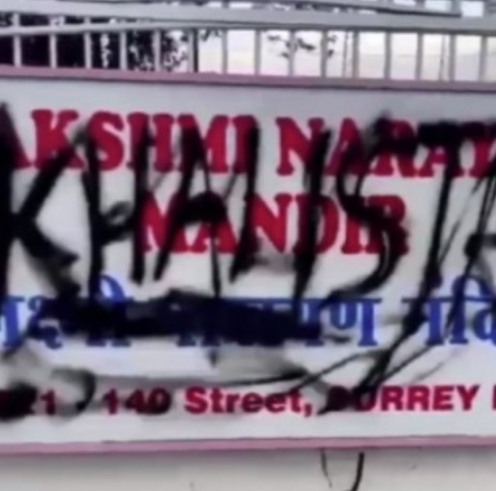

OTTAWA — A global advocacy organization has raised concerns over what it described as a pattern of provocation by Khalistani extremists targeting Hindu temples in Canada, citing recent protests in Brampton and Surrey that allegedly involved harassment of worshippers.
The Coalition of Hindus of North America said the demonstrations took place April 5 during Hanuman Jayanti celebrations, when large numbers of devotees had gathered at temples across the country.
The group said the timing of the protests, which coincided with Easter weekend and the Jewish holiday of Passover, disrupted not only Hindu worshippers but also broader neighborhoods where multiple faith communities were observing religious events.
Despite police-imposed buffer zones, the organization said temple visitors were subjected to harassment, including graphic displays and “loud, abusive slogans” directed at attendees, including children.
While authorities described the events as orderly due to police management, the group warned against equating crowd control with public safety.
“While Khalistani provocateurs engage in the worst kind of sloganeering, the burden falls on the worshippers to keep the peace — they are advised to avoid contact, adjust their movements, and navigate around a conflict they did not invite,” said CoHNA Canada President Rishabh Sarswat.
“Public safety cannot be reduced to crowd management. CoHNA is not calling for bans on symbols or speech, but we ask authorities to account for context and intent and balance the right to access a place of worship without intimidation,” he added.
Organizers of the protests have said their actions are aimed at India’s activities at temples, not at Hindus themselves, but the advocacy group rejected that claim.
“Hindu temples are autonomous institutions with the same rights as any other Canadian religious body to invite guests and host activities of their choosing — including consular services for elderly Canadians of Indian origin seeking pensions and life certificates. Who a temple chooses to host is not a decision that belongs to the CBKE,” the group said.
The organization also pointed to what it described as a broader pattern of intimidation, citing the targeting of Brampton’s Triveni Mandir as an example.
“This temple, like several others in the Greater Toronto Area, was founded and continues to be administered by the Caribbean Hindu community — a fact that underscores the hollowness of the CBKE’s attempts to frame such institutions as extensions of the Indian state,” the group said. (Source: IANS)