India Submits Seventh National Biodiversity Report Under Kunming–Montreal Framework

NEW DELHI — India has submitted its Seventh National Report on biodiversity conservation to the Convention on Biological Diversity, outlining the country’s progress toward global biodiversity goals under the Kunming–Montreal Global Biodiversity Framework.
The Ministry of Environment, Forest and Climate Change said the report, submitted Feb. 26 as part of a mandatory international requirement, reflects India’s commitment to meeting biodiversity targets by 2030.
According to the ministry, all 23 National Biodiversity Targets identified in the report are currently on track to be achieved, indicating alignment between India’s domestic policies and global conservation commitments.
Officials said the report highlights a “whole-of-government” and “whole-of-society” approach to biodiversity conservation, with participation from 33 central ministries and departments. Biodiversity protections have been integrated into policies covering infrastructure development, agriculture, forestry and coastal management.
The report noted that India has expanded biodiversity-focused land and marine planning. The country’s recorded forest area now stands at 775,377 square kilometers, representing 23.59 percent of its geographical area, while forest cover alone accounts for 520,365 square kilometers, or 15.83 percent.
Combined forest and tree cover has reached 827,356.95 square kilometers, representing 25.17 percent of the country’s land area.
India has also significantly increased the number of Ramsar wetlands — sites recognized internationally for their ecological importance — from 26 in 2014 to 98 in 2026, the report said.
The assessment uses 142 national indicators mapped against the 23 biodiversity targets and incorporates inputs from central ministries, state governments, statutory authorities, research institutions and other stakeholders.
India’s wildlife conservation network now includes 58 tiger reserves, 33 elephant reserves, 18 biosphere reserves, 106 national parks and 574 wildlife sanctuaries.
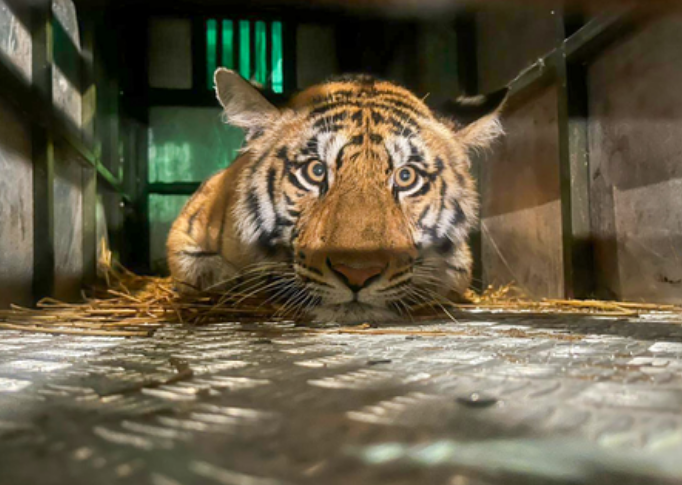
According to the report, India supports about 3,682 wild tigers — more than 70 percent of the global population — along with 4,014 greater one-horned rhinoceroses, 22,446 wild elephants, 891 Asiatic lions and roughly 718 snow leopards.
The report also highlighted the first nationwide population estimate for river dolphins, conducted under Project Dolphin, which identified approximately 6,327 river dolphins across the country.
In addition, India has documented 22 agrobiodiversity hotspots and prioritized conservation of 769 crop wild relatives across 171 native crops and 230 native animal breeds.
The country’s National Biodiversity Authority has issued more than 5,600 access and benefit-sharing agreements, distributing about ₹140 crore to support conservation efforts.
The report also noted strong community participation in biodiversity protection, with more than 276,000 Biodiversity Management Committees and over 272,000 People’s Biodiversity Registers established to document local biodiversity and traditional knowledge. (Source: IANS)