U.S. Lawmakers Press Trump Administration for Clearer Taiwan Policy

WASHINGTON, D.C. — U.S. lawmakers pressed for greater clarity and consistency in President Donald Trump’s second-term policy toward Taiwan during a congressional hearing focused on China’s efforts to marginalize the self-governed island.
The concerns were raised Wednesday during a Select Committee hearing titled “Lies, Lawfare, and Leverage: The CCP’s Gaslighting and Manipulation to Marginalise Taiwan,” where members questioned whether the administration’s approach is sufficiently clear and predictable to deter Beijing.
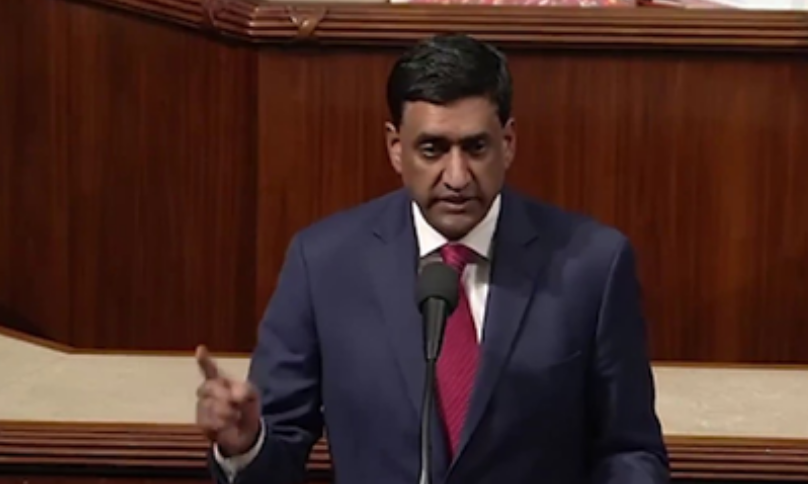
Ranking Member Ro Khanna asked witnesses whether they had concerns about the administration’s posture toward Taiwan.
“Would you say you have concerns about President Trump’s policy in his second term in terms of being clear and consistent enough to guarantee Taiwan security?” Khanna asked Shriley Kan, a founding member of the Advisory Board of the Global Taiwan Institute.
Kan responded by pointing to uncertainty surrounding the president’s approach.
“One question has been about the uncertainty of his policy from day to day. Whether the disruptions are welcome or not, is he a statesman? Or is he a peacemaker? Or is he a madman? But I do want to re-emphasise that the Taiwan Relations Act does not permit the president to decide alone on both coercion as well as use of force,” she said.
Khanna followed up by asking whether the president needed to be stronger in certain areas, particularly regarding arms sales.
“In terms of being stronger, I do not agree with the so-called packaging. We should not be talking about packages of arms sales. There should not have been eight different programs that totalled $11 billion of arms sales to Taiwan,” Kan said.
Khanna also questioned Dr. Mira Rapp-Hooper, a partner at The Asia Group, on whether the administration’s policy has been sufficiently clear.
“I do believe it would be to the benefit of the United States to see a clarification of the United States policy towards Taiwan by way of a clear statement of elements of that policy,” Rapp-Hooper said.
Julian Ku, the Maurice A. Deane Distinguished Professor of Constitutional Law at Hofstra University, suggested that stronger public messaging from the president could reinforce deterrence.
“A rhetorical campaign reaffirming from the president’s own mouth that he is affirming peaceful stability across the Taiwan Strait and that he committed to deterring any conflict (would be one way),” Ku said.
He added, “I think this administration has been a bit better on this, but the president obviously counts, so I would prefer if he would just say that the ‘One China’ policy is the policy of the United States and that his administration is committed to it just as he was in the first administration.”
Other Democratic lawmakers echoed similar concerns. Congressman Seth Moulton warned that the consequences of failure could be severe.
“Because what we are talking about is deterrence – preventing a war that would not just cost Taiwan its freedom, independence, and millions of lives, but will cost America perhaps hundreds of thousands if not millions of lives — a war that could literally be World War III,” he said.
Moulton added, “I hope we can come together in an honest, forthright, and bipartisan way to support strengthening our posture of deterrence towards China, and strengthening our alliance between Taiwan and the United States of America.”
Congresswoman Kathy Castor criticized what she described as mixed signals being sent to allies.
“In response, President Trump told her to stop provoking China. What kind of signal does that send to an ally like Japan?” she said.
She later added, “And clearly…when Trump says ‘stop provoking China,’ that would embolden Xi Jinping.”
Congresswoman Jill Tokuda emphasized that Taiwan should not be treated as a negotiating tool.
“There needs to be the beauty that Taiwan is not a bargaining chip for trade. 100 per cent…Congress needs to take decisive action to disavow this notion that somehow, they are on the negotiating table,” she said.
Congressman Greg Stanton said deterrence depends on more than military hardware.
“Deterrence is not just about a weapons system. It’s also about clarity, consistency, and credibility in American policy towards Taiwan. The PRC is watching every signal we send,” he said.
Stanton said he was disappointed by remarks suggesting Taiwan’s status was “ultimately up to Xi Jinping,” and criticized what he called the “Donroe Doctrine” as fueling speculation that the United States would focus on dominance in the Western Hemisphere while allowing China to consolidate power in East Asia.
Khanna concluded the hearing by urging bipartisan action.
“I hope that this Committee can be bipartisan in calling for more clarity in this administration’s policies to guarantee the security of Taiwan,” he said.
Under the Taiwan Relations Act of 1979, the United States maintains unofficial relations with Taiwan and is required to provide the island with defensive arms. Washington formally recognizes Beijing under its “One China” policy but opposes unilateral changes to the status quo.
Tensions across the Taiwan Strait have increased in recent years as China has intensified military and diplomatic pressure on Taiwan. (Source: IANS)