Putin’s Delhi Visit Underscores Strategic Depth of India-Russia Partnership Amid Global Shifts
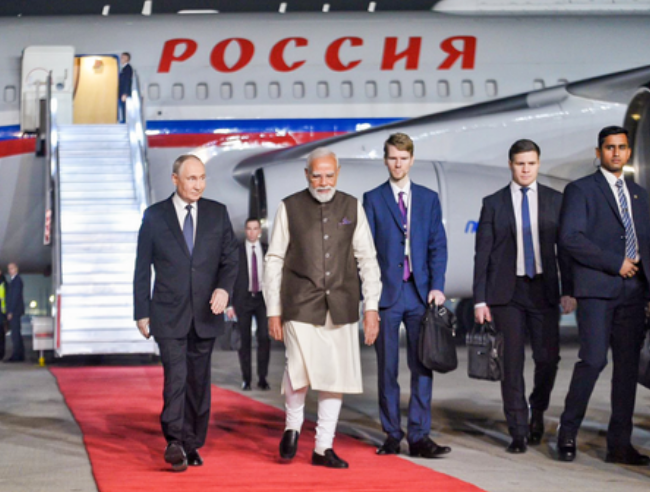

NEW DELHI– Russian President Vladimir Putin’s arrival in the Indian capital on Thursday delivered a clear geopolitical message, reinforcing the durability of the India-Russia relationship at a moment of shifting global alignments.
As Putin’s aircraft taxied to a halt at Delhi’s Palam Airport, he may not have immediately known that Prime Minister Narendra Modi was waiting on the tarmac to greet him personally — a gesture that state broadcaster RT described as a break from protocol and a sign of the two leaders’ close rapport.
The visit coincides with the 23rd India-Russia Annual Summit, a tradition established in 2000. To mark the occasion, Putin is expected to launch RT India on Friday. The Moscow-based global news network will begin broadcasting four English-language news programs daily, a move aimed at strengthening long-standing ties and projecting the countries’ roles in an increasingly multipolar world.
Kremlin spokesman Dmitry Peskov told RT that Russia and India maintain cooperation “in most sensitive areas,” a reference to defense, space, and other strategic sectors that remain central to the partnership.
Talks during the visit are set to cover joint initiatives including potential collaboration on the Sukhoi Su-57 fighter jet program, as well as broader defense and space engagements. The India-Russia Business Forum is also taking place in New Delhi this week, emphasizing commercial and industrial cooperation.
For decades, officials in New Delhi have described Russia as a uniquely hands-on partner — one willing not only to supply equipment but also to work closely with Indian teams on operation and maintenance. That dynamic has helped shape a relationship often characterized as time-tested, dating back to the era of the Soviet Union.
Strategic solidarity has marked past crises as well. During the 1971 war with Pakistan, Moscow deployed its Black Sea Fleet toward the Arabian Sea after the U.S. sent the Seventh Fleet to pressure India, prompting Washington to pull back.
More recently, India has used its diplomatic influence to moderate global narratives. At the 2023 G20 Summit in New Delhi, India negotiated a shift in the final declaration’s language — away from explicitly citing “Russian aggression” in Ukraine, as in the 2022 Bali Declaration, to the more neutral phrase “war in Ukraine.”
Russia has remained a key defense partner as well. During Operation Sindoor, Moscow’s S-400 air defense system played a critical role in repelling Pakistani aerial threats. India is now assessing the potential purchase of the more advanced S-500 Prometheus system to further strengthen its air defense architecture.
Beyond bilateral cooperation, India and Russia work together in major international platforms including BRICS, which has expanded to include Egypt, Ethiopia, Indonesia, Iran, Saudi Arabia, and the UAE, and the Shanghai Cooperation Organisation (SCO). Both groupings aim to enhance political coordination, economic development, and strategic influence across the Global South and Eurasia.
Putin arrives in New Delhi as Russia continues to face extensive Western sanctions over the war in Ukraine and as India manages tariff pressures from the United States while navigating global energy volatility. Against that backdrop, his visit serves as both a diplomatic reaffirmation and a strategic signal — underscoring a partnership that continues to evolve despite international headwinds. (Source: IANS)