New open-road tolling expected to bring faster commutes but bothersome billing

By Joe O’Connell
News at Northeastern
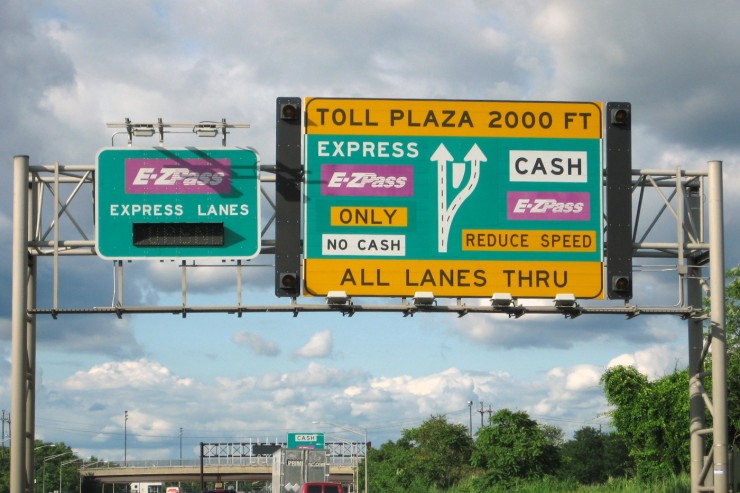
BOSTON–If you’ve traveled along the Massachusetts Turnpike recently it’s hard not to notice a series of metal overhead structures straddling both directions of the thruway. Come October, those electronic toll gantries will be the only method of fare collection for the east-west route.
These new tolls mean motorists will no longer have to stop to give their money to a toll collector, or slow down for the toll to read their E-Z Pass transponder. Instead, motorists will travel at the normal speed.
For those with a transponder, nothing will change. The new structures will read the transponder. For those without a transponder, the system will read the vehicle’s license plate and then send a bill to the address where the car is registered.
Peter Furth, professor of civil and environmental engineering and a transportation systems expert, said this step toward autonomous toll collection not only offers cost savings to the state, but will ultimately relieve traffic congestion.
“The main reason states have adopted this system has been to save money by not needing toll collectors, and motorists save time, of course,” Furth noted. “But—as transportation economists have known for decades—the real benefit will come as we start to use this technology for congestion management, adjusting tolls in response to congestion in order to keep our roads free-flowing and keep our cities from being flooded with traffic.”
While open-road tolling is not a new innovation– states such as Texas, Florida, and New Hampshire, have implemented open-road tolling in recent years–Furth said the use of license plate reading technology is fairly new.
“Only recently has license plate recognition technology become reliable enough to be cost-effective,” Furth explained, pointing to Ontario’s Highway 407, which has been cashless since 1997 but has required extensive human intervention to avoid billing errors by the license plate reading system.
Bothersome billing a drawback
However, billing errors and motorists without transponders failing to pay their bills are the most common critiques of the cashless system, Furth said. In many cases, the penalties for failing to pay a bill are significantly more than the fare itself.
“A lot of people don’t pay,” Furth said. “And states sometimes charge violation fees that can be enormous—like a $90 fee for failing to pay a $3 toll—resulting in some drivers ending up with thousands of dollars’ worth of bills. We need a better system to make payment certain without these large penalties.”
Furth added that in the future, he expects that these automated tolls will be installed not just on roads and highways where tolls already exist, but also on roads that don’t currently have them as a way to manage traffic.
“Nobody likes to pay tolls, of course, but when more people want to use a road than it has capacity for, it’s far more efficient to ration this scarce resource with pricing,” he said.
(This article is published here with permission from News at Northeastern.)